The start of a new school year changes the rhythm of the entire household.
Summer mornings become early alarms. Uniforms return to the laundry cycle. Lunch boxes need daily preparation. School bags, PE kits, homework, activities, bedtime routines, and transport schedules suddenly have to work together again.
For parents, the challenge is rarely one individual task.
It is managing dozens of small tasks at the right time, every day.
A well-organised maid can provide valuable support during this transition. She can help prepare uniforms, organise school items, assist with meals, reset the home after school, and make sure many practical household tasks are completed before they become last-minute problems.
For UAE families planning to hire a maid, the back-to-school period is also a useful reminder that effective domestic support is not simply about cleaning the home. The right household routine can give parents more time to focus on their children while keeping the practical side of school life organised.
But good support does not mean doing everything for the child.
The most effective back-to-school system has clear roles:
PARENTS LEAD
↓
CHILDREN PARTICIPATE
↓
THE MAID SUPPORTS
↓
THE ROUTINE BECOMES EASIER
This guide provides a complete back-to-school system for UAE families, covering what to prepare before school starts, what to organise every evening and morning, how a maid can help at each stage, and how to build routines that remain manageable throughout the school year.
🎒 Back to School Is a Family Transition, Not Just a School Date
The first day of school appears on the calendar as a single date.
At home, however, the transition begins much earlier.
Bedtimes need to move earlier. Children need to wake up at school time again. Uniforms have to be checked. Shoes may no longer fit. Lunch supplies need restocking. Activity schedules return. The kitchen, laundry, bedrooms, and entrance area all begin operating differently.
Trying to make all these changes on the night before school starts creates unnecessary pressure.
The better approach is to reset the household gradually.
🔄 What Changes When the Summer Routine Ends?
During school holidays, families often become more flexible.
Meals may happen later. Children stay awake longer. Mornings are slower. Laundry does not necessarily depend on whether a particular shirt or PE uniform is ready by 6:30 a.m.
School changes that flexibility.
Suddenly, several household systems become time-sensitive:
- Wake-up and bedtime.
- Breakfast.
- School uniforms.
- Laundry and ironing.
- School bags.
- Lunch boxes.
- Water bottles.
- School transport.
- Homework.
- PE days.
- After-school activities.
- Evening preparation.
A missing water bottle is a small problem at 8 p.m.
At 6:45 a.m., it can become part of a stressful morning.
That is why back-to-school preparation should focus less on doing more and more on doing things earlier.
🏠 Where Can a Maid Make the Biggest Difference?
A maid can reduce pressure by taking responsibility for agreed household support tasks that repeat throughout the school week.
Depending on the family's needs, her support may include:
- Washing and ironing school uniforms.
- Keeping children's school clothing organised.
- Preparing breakfast ingredients.
- Assisting with lunch-box preparation.
- Cleaning and resetting lunch boxes after school.
- Keeping water bottles clean and ready.
- Maintaining children's rooms.
- Organising school-related household items.
- Preparing clothes for the following morning.
- Helping keep the kitchen ready for early mornings.
- Preparing activity clothing and equipment.
- Maintaining laundry around school requirements.
- Resetting household spaces after children return home.
The greatest value often comes from consistency.
One prepared uniform does not transform a school week.
A system that keeps the correct uniforms washed, ironed, organised, and ready every school day does.
👨👩👧👦 Parents, Children, and Maid: Who Is Responsible?
A useful back-to-school routine does not transfer parental responsibility to the maid.
Nor should it remove all responsibility from children.
Instead, each person contributes appropriately.
| Family Member | Main Role |
|---|---|
| Parents | Set routines, make decisions, supervise, communicate with school |
| Children | Learn age-appropriate responsibility for their belongings and schoolwork |
| Maid | Support household preparation, organisation, meals, laundry, and agreed routines |
For example, a maid may make sure a school uniform is clean and ready.
An older child can still be responsible for getting dressed and putting dirty clothing in the correct laundry basket.
A maid may clean a lunch box and prepare food according to the parents' plan.
The parents remain responsible for decisions about nutrition, allergies, school requirements, and the child's needs.
A maid may keep the homework area clean and organised.
She should not automatically become responsible for completing or academically supervising the child's homework.
💡 BACK-TO-SCHOOL PRINCIPLE
The best household support removes unnecessary practical pressure without removing age-appropriate responsibility from the child.
🎯 Build Systems Instead of Giving Daily Instructions
A common mistake is explaining the same tasks every school day.
"Where is the PE kit?"
"Please prepare the blue uniform tomorrow."
"Don't forget the water bottle."
"Where did we put the swimming bag?"
A better system gives frequently used school items a predictable place and routine.
For example:
USE → RETURN → CLEAN → PREPARE → READY FOR NEXT TIME
Once the family and maid understand the system, fewer tasks depend on someone remembering to give instructions.
This becomes particularly valuable in households with several children, different school schedules, or multiple weekly activities.
📅 Two Weeks Before School: Start the Family Reset
Ideally, back-to-school preparation should begin before the final weekend of the holiday.
Around two weeks before school is a useful point to start checking what needs to change.
You do not need to complete everything immediately.
The goal is to identify problems early enough to solve them calmly.
📆 Check the School Calendar First
Start with information that affects the household routine.
Parents should review:
- First day of school.
- School timings.
- Transport or bus timings.
- Orientation dates.
- PE days if already available.
- Activity schedules.
- Uniform requirements.
- Lunch requirements.
- Any special items requested by the school.
Then share the practical information the maid needs.
She does not necessarily need every school email.
She does need to know information that affects her household tasks.
For example:
Monday: regular uniform
Tuesday: PE kit
Wednesday: regular uniform + swimming items
Thursday: regular uniform
Friday: PE kit
A simple schedule can prevent repeated confusion.
👕 Check Every School Uniform
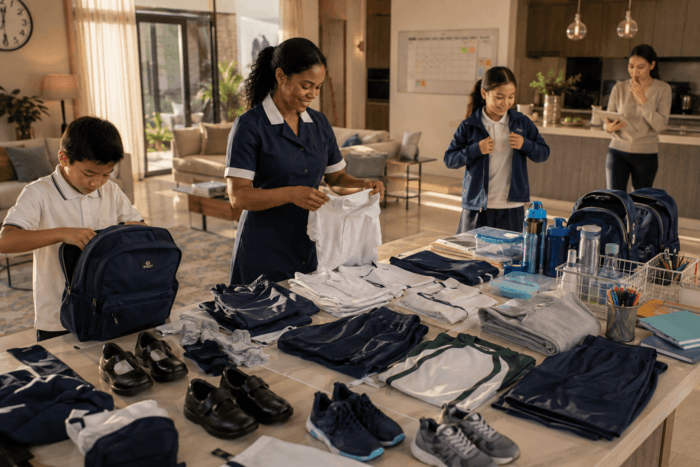
Do not assume last term's uniform is ready for the new school year.
Children grow. Clothing becomes worn. Socks disappear. Shoes become too small.
Check:
- Shirts.
- Trousers or skirts.
- Dresses where applicable.
- PE uniforms.
- School sweaters or jackets.
- Socks.
- Shoes.
- Sports shoes.
- Hats where required.
- Swimming items.
- Any school-specific accessories.
🧺 How Can the Maid Help?
The maid can make the uniform check much easier by gathering all school clothing in one place before parents review it.
She can help:
- Wash stored uniforms.
- Separate each child's clothing.
- Identify visible stains or damage.
- Match uniform sets.
- Count available shirts, trousers, skirts, and PE items.
- Check for missing socks.
- Prepare items for parents to inspect.
- Organise usable uniforms after the review.
Parents can then decide what needs replacing or purchasing.
This division saves time without asking the maid to make decisions that belong to the parents.
🎒 Inspect School Bags and Lunch Equipment
School bags often finish the previous term with forgotten papers, broken stationery, old labels, or items that no longer need to be there.
Before school begins:
- Empty each bag completely.
- Clean the inside where appropriate.
- Check zips and straps.
- Remove old papers.
- Check pencil cases.
- Inspect lunch boxes.
- Check water bottles.
- Replace damaged containers.
- Update name labels where necessary.
🧽 The Maid's Role in the School-Gear Reset
Once parents and children empty the bags and decide what should stay, the maid can help clean and organise reusable items.
She can:
- Clean suitable school bags.
- Wash lunch boxes.
- Clean water bottles thoroughly.
- Organise reusable food containers.
- Gather stationery into one place.
- Prepare labelled storage areas.
- Return cleaned items to each child's school station.
This is a good example of shared responsibility.
The child helps identify personal school belongings.
The parent decides what is needed.
The maid supports cleaning and organisation.
🏠 Reset the Home for School Mode
Back-to-school preparation is not limited to the child's bag.
The home itself needs to become ready for weekday routines again.
Consider the areas that will be used every day:
- Children's bedrooms.
- Wardrobes.
- Entrance area.
- Kitchen.
- Breakfast area.
- Homework space.
- Laundry area.
- Storage for activity equipment.
The maid can help declutter and clean these spaces before the school routine begins.
The aim is to remove unnecessary friction.
If school shoes always have one place, they are easier to find.
If lunch boxes always return to one kitchen area, they are easier to clean.
If PE equipment has a designated basket, Tuesday morning does not begin with a search around the house.
📋 14-Day Back-to-School Countdown
| When | Family Focus | How the Maid Can Help |
|---|---|---|
| 14 days before | Review calendar and school requirements | Help gather uniforms, bags, and school equipment |
| 12–13 days before | Check uniforms and shoes | Wash, sort, and organise existing uniforms |
| 10–11 days before | Inspect bags and lunch equipment | Clean reusable bags, bottles, and lunch boxes |
| 8–9 days before | Reset children's spaces | Clean and organise wardrobes and school storage |
| 6–7 days before | Begin full school sleep schedule | Support an earlier evening household routine |
| 4–5 days before | Plan breakfasts and lunches | Organise ingredients and food-storage areas |
| 2–3 days before | Confirm transport and activities | Prepare clothing and equipment according to schedule |
| 1 day before | Complete final preparation | Prepare uniforms, kitchen, lunch items, and school stations |
📌 DON'T WAIT FOR THE FINAL WEEKEND
A missing uniform, broken lunch box, or unsuitable pair of school shoes is easy to solve when discovered early. The same problem on Sunday evening creates unnecessary pressure for the entire household.
😴 Reset the Sleep Schedule Before the First School Day
One of the hardest back-to-school adjustments often has nothing to do with uniforms or school supplies.
It is sleep.
Children who have been going to bed and waking up later during the holidays may struggle if their schedule changes suddenly on the night before school.
A gradual reset is usually easier for the household.
⏰ Move Bedtime and Wake-Up Time Gradually
Instead of expecting children to move immediately from a holiday schedule to an early school bedtime, parents can begin adjusting sleep and wake times before school starts.
The exact routine will depend on the child's age and individual needs.
The important principle is consistency.
As mornings move earlier, evenings also need to become more organised.
🌙 Build a Predictable Evening Routine
A simple evening sequence might look like this:
DINNER
↓
BATH / SHOWER
↓
PREPARE TOMORROW
↓
QUIET TIME
↓
BED
The routine does not need to be identical for every child.
It does need to be predictable enough that the household is not trying to prepare for tomorrow after the children should already be sleeping.
🧹 How Can a Maid Support Better School-Night Routines?
A maid should not be responsible for deciding a child's bedtime.
But she can help remove practical household tasks that delay the evening.
For example, she can:
- Make sure tomorrow's uniform is ready.
- Finish essential school laundry earlier.
- Clean lunch boxes before the evening.
- Prepare breakfast items where appropriate.
- Organise water bottles.
- Reset the kitchen after dinner.
- Prepare clothing needed for the next day's activities.
- Keep children's rooms and bathrooms ready for the evening routine.
This allows parents to focus more attention on the children rather than discovering at bedtime that tomorrow's PE uniform is still in the laundry.
👨👩👧 What Should Parents Continue to Manage?
Parents remain responsible for the child's overall sleep routine.
That includes decisions about:
- Bedtime.
- Screen use.
- Evening behaviour.
- Age-appropriate sleep needs.
- Emotional adjustment to returning to school.
- Changes required when the child struggles with the new routine.
The maid supports the household conditions around bedtime.
Parents manage the child's sleep.
That distinction should remain clear.
🌙 THE NIGHT-BEFORE RULE
If a task can be completed safely and practically the night before, avoid leaving it for the school morning.
Tonight's preparation = Tomorrow morning's time.
👕 School Uniforms: Build a System Before the Morning Rush
School uniforms are one of the most predictable parts of the school week.
That makes last-minute uniform problems especially avoidable.
A shirt that needs ironing, a missing sock, a PE kit still in the laundry, or sports shoes that cannot be found can turn an otherwise organised morning into a rush.
The solution is not simply washing uniforms more often.
It is creating a uniform system that parents, children, and the maid all understand.
🧺 Create a Weekly Uniform Cycle
Start by checking how many uniform sets each child has and when different items are needed.
A simple system might follow this cycle:
WEAR → DIRTY LAUNDRY → WASH → DRY → IRON → ORGANISE → READY
The maid can manage much of this practical cycle once parents have explained the school's uniform requirements.
For families with more than one school-age child, keeping each child's uniform separate becomes particularly important.
Useful methods include:
- Separate wardrobe sections.
- Labelled hangers.
- Different laundry baskets where practical.
- Dedicated drawers for socks and accessories.
- A separate place for PE clothing.
- A basket or shelf for activity uniforms.
The system should be simple enough to maintain every week.
👔 Prepare Tomorrow's Uniform the Night Before
Even if all uniforms are clean, choosing and preparing the correct set the night before can save valuable time.
The maid can check the weekly schedule and lay out or hang:
- Shirt or top.
- Trousers, skirt, or dress.
- Socks.
- PE clothing when required.
- Sweater or jacket when needed.
- Any school-specific accessories.
Shoes can also be returned to their designated place.
Older children should gradually participate in this routine.
For example, the maid can ensure the uniform is clean and available, while the child checks that the correct set is ready for tomorrow.
🏃 Don't Forget PE and Activity Clothing
Regular uniforms are usually easier to remember because they are worn most days.
PE kits, swimming items, and activity clothing are more likely to create problems because they follow specific schedules.
Create a visible weekly reminder.
MONDAY — Regular Uniform
TUESDAY — PE Kit
WEDNESDAY — Regular Uniform + Swimming
THURSDAY — Regular Uniform
FRIDAY — PE Kit
The exact schedule will vary by school and child.
Once the maid knows the weekly pattern, she can organise laundry so that special clothing is ready before it is needed.
📅 Weekly Uniform Preparation Plan
| Day | Uniform Need | Child's Role | Maid's Support |
|---|---|---|---|
| Monday | Regular uniform | Put worn clothes in laundry | Prepare Tuesday's required clothing |
| Tuesday | PE / school requirement | Return PE items after school | Wash and reset used items |
| Wednesday | Regular / special activity | Check tomorrow's schedule | Prepare correct uniform and accessories |
| Thursday | Regular uniform | Keep personal items together | Check Friday clothing and PE items |
| Friday | Friday school requirements | Return all school clothing | Begin weekend uniform reset |
| Saturday | No regular school | Help identify missing items | Wash, dry, iron, and organise |
| Sunday | Final weekly preparation | Check Monday's needs | Complete uniform check for Monday |
💡 UNIFORM RULE
The goal is not to ask every evening, "Is the uniform ready?" The goal is to build a system where the correct uniform is normally ready before anyone needs to ask.
🎒 School Bags: What Should Be Checked Every Day?
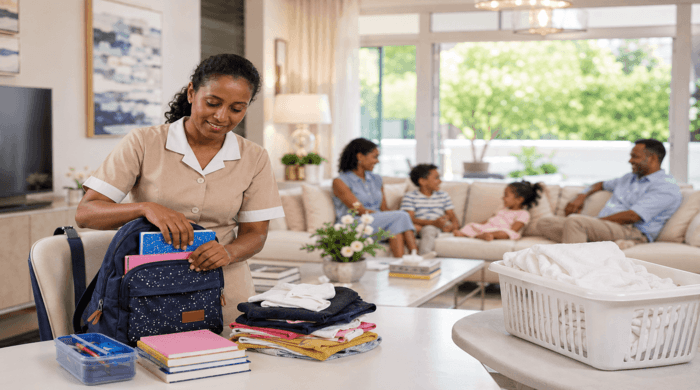
A school bag should not become a storage space for the entire term.
Papers accumulate. Empty snack wrappers remain inside. Activity items get forgotten. Water bottles disappear into side pockets.
A short daily reset keeps the bag manageable.
But there is an important distinction:
Helping a child prepare a school bag is not the same as taking complete responsibility for it.
📚 What Should Be Checked?
Depending on the child's age and school requirements, the daily check may include:
- Required books.
- Homework or worksheets.
- Pencil case.
- School diary or planner.
- Lunch box.
- Water bottle.
- PE clothing.
- Swimming items.
- Activity equipment.
- School notices.
- Any special item needed the following day.
Older children should increasingly manage these items themselves.
Younger children may need more support.
🧒 What Should the Child Do?
Age-appropriate independence matters.
A child may be able to:
- Empty unnecessary papers.
- Put homework into the bag.
- Check the school timetable.
- Pack books.
- Return the water bottle to the kitchen.
- Place the lunch box in the cleaning area.
- Tell an adult about a school notice.
- Remember special activity requirements.
The exact responsibilities depend on age and maturity.
🧹 How Can the Maid Help with School Bags?
The maid can support the practical side of the routine.
For example, she can:
- Remove and clean the lunch box once it is returned.
- Wash the water bottle.
- Keep the bag storage area organised.
- Prepare cleaned PE clothing.
- Place activity equipment in its designated area.
- Keep frequently used supplies available.
- Alert parents if she notices damaged or missing household-prepared items.
For younger children, she may provide more direct support according to the parents' instructions.
For older children, her role can gradually shift toward keeping the system around the bag organised rather than packing everything herself.
🎒 INDEPENDENCE TIP
A useful progression is:
DO FOR THEM → DO WITH THEM → REMIND THEM → THEY DO IT
As children grow, the maid's support should help them become more organised—not make them dependent on someone else remembering everything.
🏠 Create a Back-to-School Command Station at Home
One of the simplest ways to reduce school-morning stress is to stop storing school items in random places.
Create one designated area where frequently used school belongings return every day.
It does not need to be a large or elaborate space.
A section near the entrance, a hallway cabinet, a shelf, or several labelled baskets may be enough.
📍 What Should the School Station Include?
Depending on the space available, consider designated places for:
- School bags.
- Shoes.
- Lunch boxes.
- Water bottles.
- PE bags.
- Swimming bags.
- Activity equipment.
- School notices.
- Items that need to leave the house the next morning.
A simple visual system can work well:
🎒 BAGS | 👟 SHOES | 🍱 LUNCH | 💧 BOTTLES | 📄 PAPERS | ⚽ ACTIVITIES
🧹 How Can the Maid Maintain the School Station?
A system only works if it is reset.
The maid can help by:
- Keeping the area clean.
- Returning household-prepared items to their places.
- Removing lunch boxes for cleaning.
- Returning clean bottles when ready.
- Keeping activity bags together.
- Organising prepared uniforms nearby where appropriate.
- Identifying items left in the wrong place.
- Restocking agreed household supplies.
Children should still be encouraged to return their own bags and shoes.
The maid maintains the environment.
The child learns to use it.
📅 Add a Visible Family Calendar
A calendar can turn scattered information into one shared weekly picture.
Include relevant events such as:
- PE days.
- Swimming days.
- School trips.
- Clubs.
- Sports practice.
- Special uniform days.
- Early dismissal.
- Items that need to be taken to school.
Parents control and update the schedule.
Older children can learn to check it.
The maid can use the practical parts of the calendar to anticipate household preparation.
For example, if Wednesday is swimming day, she knows that the swimming kit needs to be clean and ready by Tuesday evening.
🧺 Use One Basket Per Child
For families with several children, mixing belongings creates unnecessary confusion.
A simple labelled basket for each child can hold items waiting for the next school day.
CHILD 1 → School / Activity Items
CHILD 2 → School / Activity Items
CHILD 3 → School / Activity Items
This does not need to contain everything.
It simply provides a temporary home for items that otherwise end up on kitchen counters, sofas, stairs, or dining tables.
📌 ORGANISATION PRINCIPLE
Every school item that is used repeatedly should have a predictable place to leave from and return to.
🍎 School Lunches and Snacks Without the Daily Stress
School lunch preparation can become one of the most repetitive parts of the week.
The difficult part is rarely making one lunch.
It is making suitable lunches every school day while also managing breakfast, work schedules, children's preferences, school rules, allergies, and the rest of the morning routine.
Planning reduces that pressure significantly.
🗓️ Plan Lunches Before the Week Begins
Parents can decide the general lunch plan based on:
- The child's age.
- School rules.
- Food preferences.
- Nutritional needs.
- Allergies or intolerances.
- Length of the school day.
- Available storage or cooling arrangements.
- After-school activities.
The maid can then support preparation according to that plan.
This avoids the daily question:
"What are we putting in the lunch box today?"
🍱 Use a Simple Lunch Formula
Rather than inventing a completely different lunch every morning, families can use a simple structure.
For example:
MAIN ITEM + FRUIT/VEGETABLE + SNACK + WATER
The exact foods should be chosen by the parents according to the child's needs and school requirements.
The structure simply makes preparation easier.
👩🍳 How Can a Maid Help with School Lunches?
Depending on the family's arrangement, the maid can help:
- Wash fruit and vegetables.
- Prepare agreed ingredients.
- Portion suitable snacks.
- Prepare sandwiches or other planned foods.
- Fill lunch containers according to parental instructions.
- Keep lunch equipment organised.
- Clean lunch boxes after school.
- Monitor household stocks of commonly used items.
- Prepare ingredients the evening before when appropriate.
- Keep the kitchen clean during preparation.
This can save parents significant time while keeping decisions about the child's diet with the family.
⚠️ Treat Allergies and School Food Rules Seriously
If a child has a known allergy or dietary restriction, the maid needs clear instructions.
Do not rely on vague directions such as:
"She can't eat some nuts."
Make the rule explicit.
Parents should explain:
- Which foods must be avoided.
- Cross-contact precautions where relevant.
- Which products are approved.
- Whether school rules prohibit certain foods.
- What the maid should do if she is uncertain about an ingredient.
When in doubt, she should ask rather than guess.
🌡️ Think About Food Safety
Food preparation for school also needs to account for how long food will remain out of normal refrigeration and the conditions in which it will be stored.
Families should choose foods and storage methods appropriate for the child's school arrangements and follow relevant food-safety guidance.
The maid's role is to follow the family's established preparation and storage instructions consistently.
📋 5-Day School Lunch Planner
| Day | Main Item | Fruit / Vegetable | Snack | Maid Preparation |
|---|---|---|---|---|
| Monday | Family choice | Prepared portion | Planned snack | Prepare ingredients and pack as instructed |
| Tuesday | Family choice | Prepared portion | Planned snack | Check supplies and prepare lunch |
| Wednesday | Family choice | Prepared portion | Planned snack | Prepare and reset containers |
| Thursday | Family choice | Prepared portion | Planned snack | Check remaining weekly ingredients |
| Friday | Family choice | Prepared portion | Planned snack | Prepare lunch and identify items to restock |
The purpose of the planner is not to make every week identical.
It is to move decisions away from the busiest part of the morning.
🛒 The Weekly Back-to-School Food Preparation System
School-food organisation becomes much easier when preparation happens at several small points during the week rather than entirely each morning.
A simple system is:
PLAN → SHOP → PREP → STORE → PACK → RESTOCK
📝 Parents Plan
Parents decide the menu and any dietary requirements.
They also consider special school days or activities that may affect meals.
🛒 Shop for the Week
Create a recurring school-food list containing frequently used items.
This might include:
- Breakfast ingredients.
- Lunch ingredients.
- Fruit and vegetables.
- Approved snacks.
- Drinks where applicable.
- Food-storage supplies.
The exact list will vary by household.
🔪 The Maid Prepares
Once the family's choices are clear, the maid can complete suitable advance preparation.
That might mean:
- Washing produce.
- Organising ingredients.
- Preparing suitable food components.
- Checking lunch containers.
- Keeping breakfast ingredients accessible.
- Organising the refrigerator or pantry.
- Identifying supplies that are running low.
📦 Store for Easy Access
Frequently used school-food items should be easy to locate.
If every lunch preparation requires searching through several cupboards, the system is unnecessarily difficult.
A dedicated section for approved school snacks or lunch-box items can save time for both parents and the maid.
🔄 Restock Before You Run Out
Do not wait until Monday morning to discover there are no lunch-box essentials left.
The maid can help identify low household supplies during the week and inform the parents before the next shopping trip.
🍎 MEAL-PREP PRINCIPLE
Parents decide what children should eat. The maid can help make sure the agreed food is prepared, organised, packed, and ready at the right time.
🌅 Build a Morning Routine That Actually Works

A smooth school morning rarely begins in the morning.
It begins the night before.
When uniforms, bags, lunch items, activity equipment, and breakfast essentials are already organised, the morning becomes a sequence of predictable steps rather than a series of last-minute decisions.
The goal is not to create a military schedule.
It is to remove unnecessary decisions from the busiest part of the day.
🌙 Prepare as Much as Possible the Night Before
Before the household settles for the evening, check the items that can reasonably be prepared in advance.
The maid can help make sure:
- The correct uniform is clean, ironed, and ready.
- PE or activity clothing is prepared.
- Shoes are in their designated place.
- Lunch boxes and water bottles are clean.
- Breakfast items are organised.
- Suitable lunch ingredients are prepared.
- The kitchen has been reset.
- Frequently used school items are in their normal places.
Children can check their school timetable and pack the items they are responsible for.
Parents can review anything requiring their attention, such as school notices, special events, or schedule changes.
By bedtime, the household should ideally be preparing to sleep, not still trying to solve tomorrow morning.
⏰ Work Backwards from the Time You Need to Leave
Instead of choosing a random wake-up time, start with the time the family needs to leave the house or meet the school bus.
Then work backwards.
For example:
7:15 — Leave / Bus
↑
7:05 — Shoes + Final Check
↑
6:45 — Breakfast
↑
6:25 — Dress + Get Ready
↑
6:15 — Wake Up
The exact timings will differ between families.
The principle is what matters.
Allow enough time for the normal routine plus a small buffer for the unexpected.
🍳 Give the Maid a Clear Morning Sequence
A maid can provide significant support during the school morning, but only if her priorities are clear.
A practical sequence might be:
KITCHEN READY
↓
BREAKFAST PREPARED
↓
LUNCH ITEMS FINALISED
↓
WATER BOTTLES READY
↓
QUICK HOUSEHOLD SUPPORT
↓
RESET AFTER FAMILY LEAVES
The exact order depends on the household.
If there are several children, the maid should know which tasks are genuinely time-sensitive and which can wait until after the school run.
🚫 Don't Schedule Non-Urgent Household Tasks During the Morning Rush
The school morning is usually not the ideal time for deep cleaning, reorganising cupboards, or completing non-urgent laundry.
Where possible, the maid's workload should reflect the family's busiest periods.
During the morning peak, priority may shift toward:
- Breakfast.
- Lunch preparation.
- Uniform-related support.
- Children's practical needs.
- Kitchen organisation.
- Items that must leave the house.
Once the family leaves, regular household tasks can resume.
This is one of the advantages of having a clearly structured live-in maid: recurring household tasks can be organised around the family's daily rhythm instead of competing with the most time-sensitive parts of the school routine.
🚪 Create a Final Door-Check Routine
The last five minutes before leaving should not involve searching the entire house.
Create a short final check appropriate for each child.
For example:
🎒 BAG
🍱 LUNCH
💧 WATER
👟 SHOES
⚽ ACTIVITY ITEM
🚌 GO
The child should participate in this check.
The maid can help ensure household-prepared items are in their designated places, while parents supervise younger children where necessary.
⏰ MORNING RULE
If the same problem happens three mornings in a row, don't simply try to move faster on the fourth morning. Change the system that is causing the delay.
⏰ Who Does What in the Morning?
One of the easiest ways to make a school routine confusing is to assume everyone knows what they are responsible for.
Clear roles make the morning more predictable.
The exact division will depend on the child's age, family structure, and responsibilities agreed with the maid.
👨👩👧 What Should Parents Manage?
Parents remain responsible for the overall school routine.
This may include:
- Deciding wake-up and departure times.
- Managing school communication.
- Making nutritional decisions.
- Monitoring children's wellbeing.
- Supervising younger children.
- Managing transport.
- Checking important school requirements.
- Responding to unusual situations.
Domestic support can reduce the practical workload.
It does not replace parental responsibility.
🧒 What Can Children Manage?
Even young children can gradually learn small responsibilities.
Depending on age, children may:
- Get dressed.
- Put on their shoes.
- Bring their school bag to the door.
- Check their timetable.
- Pack certain school items.
- Carry their lunch box.
- Return dirty clothes appropriately.
- Remember activity equipment with reminders.
Older children should generally take greater responsibility for their own belongings and schedules.
🧹 What Can the Maid Support?
The maid's morning role can focus on household preparation.
She may:
- Prepare breakfast as agreed.
- Finalise planned lunch boxes.
- Prepare water bottles.
- Keep uniforms ready.
- Assist younger children with practical tasks where agreed.
- Keep the kitchen functioning during the morning rush.
- Make sure prepared household items are in their usual places.
- Reset the kitchen and home after the family leaves.
📊 Parent vs Child vs Maid: Morning Responsibilities
| Morning Task | Parent | Child | Maid |
|---|---|---|---|
| Wake-up schedule | Decide / supervise | Follow | Support household timing |
| Getting dressed | Supervise if needed | Primary role | Practical help for younger children if agreed |
| Uniform availability | Set requirements | Check / wear | Wash, iron, organise |
| Breakfast | Decide needs | Eat / participate | Prepare as agreed |
| Lunch box | Decide food plan | Carry / check | Prepare and pack as agreed |
| School bag | Supervise when needed | Primary responsibility as age allows | Keep surrounding system organised |
| Water bottle | Set requirements | Remember / carry | Clean and prepare |
| School notices | Review | Deliver / communicate | Not primary responsibility |
| Transport | Arrange | Be ready | Support preparation |
| Final door check | Supervise | Participate | Ensure household-prepared items are ready |
The objective is not to create rigid boundaries for every household.
It is to avoid a situation where everyone assumes someone else remembered the same task.
🚌 The After-School Routine: The Part Families Often Forget
Families often put enormous effort into getting children out of the house in the morning.
But tomorrow's successful morning begins when they return home today.
School bags arrive.
Shoes come off.
Lunch boxes return.
Uniforms need washing.
Children may be hungry or tired.
Homework and activities still need attention.
Without a simple arrival-home routine, school items gradually spread across the house and preparation is pushed into the evening.
🏠 Create a Consistent Arrival Sequence
A simple routine might look like:
HOME
↓
BAG + SHOES AWAY
↓
LUNCH BOX TO KITCHEN
↓
CHANGE CLOTHES
↓
EAT / REST
↓
HOMEWORK / ACTIVITY
↓
RESET FOR TOMORROW
Children do not need to perform every step independently from the first day.
The routine can develop gradually.
🎒 Bags and Shoes Return to Their Places
The school station created before term begins becomes especially useful now.
Children can learn:
Bag → Bag station
Shoes → Shoe area
Lunch box → Kitchen
Water bottle → Cleaning area
Dirty uniform → Laundry
The maid can reinforce the system by maintaining those areas rather than repeatedly collecting belongings from around the house.
🍱 Deal with Lunch Boxes Immediately
A lunch box left inside a school bag until late evening creates unnecessary work.
Once the child returns, the lunch box should be brought to the kitchen.
The maid can:
- Empty leftovers appropriately.
- Clean the lunch box.
- Wash reusable containers.
- Clean the water bottle.
- Allow items to dry properly.
- Return everything to the lunch-preparation area.
The lunch system is then reset hours before it is needed again.
👕 Put Uniforms Straight into the Laundry System
Uniforms should also enter the established cycle quickly.
Instead of leaving school clothes on the bedroom floor:
WEAR → LAUNDRY → WASH → DRY → IRON → READY
The maid can decide the appropriate laundry timing based on how many uniform sets are available and when particular items are needed again.
If tomorrow is PE day, PE clothing takes priority over a household item that is not urgently required.
🍎 Prepare the After-School Meal or Snack
Children often arrive home hungry.
Having an agreed meal or snack ready can make the transition easier and reduce random snacking while parents are still working or managing other responsibilities.
Parents decide the food plan.
The maid can help:
- Prepare the agreed meal.
- Have water available.
- Serve food according to the household routine.
- Clean the kitchen afterwards.
- Prepare food around activity timings where necessary.
😌 Give Children Time to Transition
Not every child is ready to begin homework the moment they walk through the door.
The family may choose to allow time for:
- Eating.
- Changing clothes.
- Resting.
- Talking about the day.
- Quiet play.
- Preparing for an activity.
The maid's role is not to decide how much rest a child needs.
She can support the routine by keeping the surrounding household tasks organised while parents manage the child's schedule.
🏠 AFTER-SCHOOL PRINCIPLE
Don't think of after-school organisation as cleaning up today's mess. Think of it as starting tomorrow's preparation early.
📚 Homework Time: Support Without Doing the Child's Work
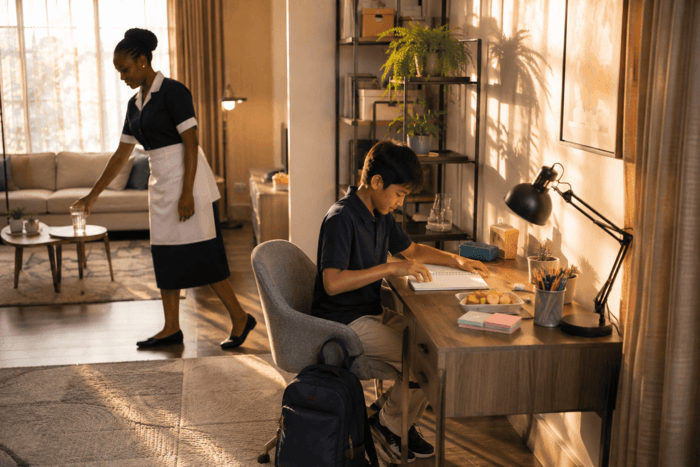
A maid can help create conditions that make homework easier.
That is different from becoming responsible for the child's education.
Academic supervision, decisions about learning, communication with teachers, and concerns about school performance remain parental responsibilities.
🪑 Prepare a Consistent Homework Space
Children often work more easily when basic supplies are already available.
The homework area might contain:
- Pencils and pens.
- Erasers.
- Ruler.
- Paper.
- Age-appropriate stationery.
- A suitable desk or table.
- Good lighting.
- Water.
The maid can help keep the area clean and return general supplies to their places.
🍎 Remove Practical Interruptions
Once homework begins, repeated interruptions can make concentration more difficult.
The maid can support the environment by:
- Preparing a snack beforehand.
- Providing water.
- Keeping the immediate area organised.
- Completing noisy household tasks at another time where practical.
- Keeping younger siblings occupied according to the family's arrangements where appropriate.
These are household-support functions.
They help create an environment where the child can concentrate.
🚫 What Should the Maid Not Be Expected to Do?
Unless a specific childcare or educational role has been agreed and the person is appropriately capable, families should not automatically expect a maid to:
- Teach school subjects.
- Correct academic work.
- Complete homework.
- Manage school projects.
- Communicate academically with teachers.
- Take responsibility for the child's learning progress.
Helping a child locate a pencil is household support.
Completing a worksheet for the child is not.
👩👧 When Does the Family Need More Child-Focused Support?
If the household's main need extends beyond practical home support into regular childcare, supervision, school pickups, children's routines, and child-focused activities, families may need to consider whether a nanny is more appropriate for the role.
Defining this distinction clearly helps both the family and domestic worker understand expectations from the beginning.
📚 HOMEWORK RULE
The maid can prepare the environment. The child does the learning. The parents remain responsible for education.
⚽ After-School Activities Need Their Own System
Football on Monday.
Swimming on Wednesday.
Dance on Thursday.
A club on Friday.
For families with several children, after-school activities can create almost as much organisation as school itself.
The problem is usually not the activity.
It is the equipment surrounding it.
📅 Put Activities on the Same Family Calendar
Do not manage school and activities as two separate worlds.
The weekly family calendar should include both.
For example:
| Day | School Requirement | After-School Activity | Maid Preparation |
|---|---|---|---|
| Monday | Regular school day | Football | Prepare clean sportswear, bottle, and agreed equipment |
| Tuesday | PE | None | Wash and reset PE kit |
| Wednesday | Swimming | Swimming / lesson | Prepare clean swim items and towel |
| Thursday | Regular school day | Dance / club | Prepare activity clothing and bag |
| Friday | PE / school requirement | Family schedule | Begin activity and uniform reset |
🎽 Give Every Activity Its Own Bag
Where practical, keep frequently used activity equipment together.
For example:
SWIMMING BAG
- Swimwear.
- Towel.
- Goggles.
- Other required items.
Or:
FOOTBALL BAG
- Sports clothing.
- Appropriate shoes.
- Required equipment.
- Water bottle when prepared.
Parents decide what each activity requires.
The child learns what belongs in the bag.
The maid can keep washable items clean and help reset the bag after use.
🔄 Reset the Activity Bag After Every Use
Do not wait until the next activity day.
When the child returns:
EMPTY → WASH → DRY → RETURN → READY
The maid can take out wet or dirty clothing, wash what is needed, clean suitable containers, and return reusable items to the activity area.
This prevents the familiar problem of discovering wet swimming clothes inside a bag several days later.
🥪 Plan Food Around Activities
After-school activities can change meal timings.
A child going directly to sports practice may need a different food routine from a child returning home for the afternoon.
Parents should decide what is appropriate.
The maid can then help ensure the agreed snack, meal, and water are prepared at the correct time.
⚽ ACTIVITY RULE
Every recurring activity should have:
A DAY + A BAG + A STORAGE PLACE + A RESET ROUTINE
Once those four elements are clear, weekly activities become much easier to manage.
🧺 The Daily School Reset: 20 Minutes That Save Tomorrow Morning
One of the most useful back-to-school habits is also one of the simplest.
Do not wait until bedtime to prepare for tomorrow.
Create a short daily school reset after the children return home.
The exact timing will depend on the household. It does not have to take exactly 20 minutes, and not every task needs to be completed at the same moment.
The idea is simple:
TODAY'S SCHOOL DAY
↓
EMPTY + CLEAN + CHECK + RESET
↓
TOMORROW IS ALREADY STARTED
🍱 Step 1: Reset Lunch Boxes and Bottles
Once lunch boxes and water bottles reach the kitchen, the maid can:
- Empty remaining food appropriately.
- Wash reusable containers.
- Clean bottles.
- Allow everything to dry.
- Return clean items to the lunch-preparation area.
- Identify damaged containers that need replacing.
This removes one complete task from the evening.
👕 Step 2: Start the Uniform Cycle
School uniforms and PE clothing should enter the laundry system as soon as practical.
The maid can check what is needed next and prioritise accordingly.
For example, if a particular PE shirt is required tomorrow, it should not wait behind non-urgent household laundry.
The objective is not simply to keep clothes clean.
It is to keep the right clothes available at the right time.
📄 Step 3: Deal with School Papers
Children should be encouraged to give parents important notices rather than leaving them inside their bags.
For younger children, the maid may notice papers while helping with the after-school routine.
She can place them in a designated Parents' School Papers area.
Parents remain responsible for:
- Reading school communication.
- Signing forms.
- Making payments.
- Responding to teachers.
- Acting on academic information.
- Adding important dates to the family calendar.
This prevents an important permission slip from disappearing underneath a pile of household papers.
🎒 Step 4: Check Tomorrow's Practical Requirements
Parents or older children can check tomorrow's timetable.
The maid only needs the information that affects household preparation.
For example:
Tomorrow = PE
The maid knows the PE kit must be ready.
Tomorrow = Swimming
She can make sure the clean swimming items and towel are available.
Tomorrow = Special school event
Parents decide what is required and explain any practical preparation needed.
🧹 Step 5: Return Everything to Its Station
At the end of the reset:
- Bags return to the school station.
- Shoes return to their place.
- Clean lunch equipment returns to the kitchen area.
- Activity equipment returns to designated storage.
- Uniform preparation begins.
- Household supplies are checked.
Tomorrow's morning has now partially been prepared before today's evening has even started.
⏱️ THE 20-MINUTE RESET
Lunch → Laundry → Papers → Tomorrow → Reset
A short routine repeated every school day is more effective than a major search-and-prepare session every morning.
🧹 How a Maid Can Keep the School-Week Home Organised
During the school term, domestic work does not disappear.
Cleaning, laundry, ironing, cooking, kitchen organisation, and other household responsibilities continue.
What changes is when certain tasks become most important.
An effective school-week routine adapts domestic tasks around the family's schedule.
⏰ Organise Household Tasks Around Peak Hours
There are usually several high-pressure periods in a school household:
Before school → After school → Before activities → Evening preparation
Non-urgent household tasks can often be scheduled around these periods.
For example, deep cleaning a room may be less important at 6:30 a.m. than preparing breakfast and ensuring school-related household items are ready.
After the children leave, the maid can return to regular cleaning and household work.
🧺 Make Laundry Follow the School Calendar
School laundry should not operate randomly.
The maid can use the weekly schedule to prioritise:
- Regular uniforms.
- PE clothing.
- Swimming items.
- Sportswear.
- Activity clothing.
- Frequently needed socks and accessories.
This does not mean school items always need immediate washing.
It means the maid knows when they are needed again.
That single piece of information makes laundry planning much more efficient.
🛏️ Keep Children's Spaces Functional
During busy school weeks, children's rooms can quickly accumulate:
- School clothes.
- Books.
- Activity items.
- Shoes.
- Bags.
- Papers.
- General clutter.
The maid can keep rooms clean and help maintain the storage system established by the family.
Children should still participate according to their age.
For example, a child may be responsible for putting toys away or returning books to a shelf before the maid completes routine cleaning.
🍳 Keep the Kitchen Ready for School Days
The kitchen becomes one of the busiest school-week areas.
It handles:
- Breakfast.
- Lunch-box preparation.
- After-school meals.
- Snacks.
- Water bottles.
- Dinner.
- Food preparation for tomorrow.
The maid can reduce friction by resetting the kitchen after each major use rather than allowing tasks to accumulate.
A clean lunch-preparation area at night makes the next morning easier.
📦 Keep School Supplies Visible Before They Run Out
Some school-related household items are used repeatedly.
Instead of discovering that an essential item has run out at the last minute, the maid can notify parents when agreed supplies are becoming low.
This might include frequently used food-storage items or other household supplies needed for the school routine.
The parent decides what to purchase.
The maid helps identify what needs restocking.
🗣️ Use a Short Daily Handover
A two-minute conversation can sometimes prevent several problems.
Parents can tell the maid:
"Tomorrow is PE."
"There is swimming after school."
"We need to leave 20 minutes earlier tomorrow."
"No lunch box tomorrow because there is a school event."
This is much easier than expecting her to infer changes.
📌 GOOD DOMESTIC SUPPORT NEEDS INFORMATION
A maid cannot organise around a schedule she does not know. Share the practical information that affects her responsibilities, especially when tomorrow is different from a normal school day.
👩👧 Maid or Nanny: Who Should Handle Child-Related School Support?
Back-to-school routines can reveal an important distinction between household support and childcare.
A maid may provide extensive practical support around a child's school day.
But some families need a role that focuses much more directly on the child.
Understanding the difference helps families set realistic expectations.
🧹 When Is Maid Support Usually the Main Need?
A maid may be suitable when the family's main requirements revolve around household tasks such as:
- Preparing uniforms.
- Laundry and ironing.
- Meal preparation.
- Lunch boxes.
- Cleaning children's spaces.
- Organising school-related household items.
- Maintaining the kitchen.
- Preparing activity clothing.
- Supporting established morning and evening routines.
The child remains primarily under parental direction, while the maid keeps the practical household system working.
👩👧 When Does the Role Become More Child-Focused?
A family may need more dedicated childcare when responsibilities regularly include:
- Direct supervision of younger children.
- Managing substantial parts of the child's daily routine.
- Caring for children for extended periods.
- Child-focused activities.
- Regular school-related supervision.
- Supporting younger children throughout the day.
- Managing routines where childcare is the central responsibility rather than household work.
The exact duties should always be discussed clearly before hiring.
⚖️ The Difference in One Simple Question
Ask:
"If the household were already clean and organised, what would we still need this person to spend most of her time doing?"
If the answer is mainly:
Cleaning, laundry, cooking, ironing, and household organisation
→ the primary need is likely domestic support.
If the answer is mainly:
Supervising and caring for the children
→ the family may need a more child-focused role.
The distinction can become especially important for families with babies, toddlers, or younger school-age children.
🤝 Avoid Creating Two Full-Time Jobs for One Person
A common problem is expecting one worker to perform a complete household workload while simultaneously providing continuous childcare.
These responsibilities can compete with each other.
A person cannot supervise a young child closely while also being expected to deep-clean another part of the home at exactly the same time.
Families should therefore prioritise responsibilities realistically.
💡 ROLE CLARITY
A successful school routine does not depend on giving the maid more tasks. It depends on giving her clear, realistic, well-prioritised tasks.
🗣️ Talk to Your Maid Before School Starts
Even a well-designed back-to-school plan can fail if only one person understands it.
Before the school term begins, explain the routine to the maid.
Do not assume that because she has worked with children before, she automatically knows how your children's school week operates.
Every family is different.
📅 Explain Each Child's Schedule
For each school-age child, explain the practical information that affects household preparation:
- School days.
- Departure time.
- Return time.
- PE days.
- Swimming days.
- Activity schedule.
- Special uniform requirements.
- Regular lunch requirements.
- Any recurring weekly differences.
A simple written weekly planner may be easier to follow than repeated verbal instructions.
👕 Walk Through the Uniform System
Show the maid:
- Where clean uniforms are stored.
- Where dirty school clothing goes.
- Which items belong to which child.
- Where PE kits are kept.
- Where activity clothing is stored.
- Which items require special care.
- What should be ready each evening.
If there are several children, labels can reduce confusion.
🍱 Explain the Food Routine Clearly
Parents should explain:
- What is normally prepared for breakfast.
- What goes into lunch boxes.
- Foods that should not be packed.
- Allergy or dietary instructions.
- Where lunch supplies are stored.
- Which items can be prepared in advance.
- What should be made fresh.
- What happens on activity days.
Clear instructions are especially important where children's food is concerned.
🚪 Show the Morning Sequence
Instead of simply saying:
"Help us in the morning,"
explain what that actually means.
For example:
6:00 — Kitchen preparation
6:20 — Breakfast ready
6:40 — Lunch boxes finalised
6:50 — Bottles and prepared items at school station
7:10 — Family leaves
The maid can then organise her work around actual priorities.
🌆 Explain the After-School Reset
The return-home routine should also be clear.
For example:
Lunch box → Kitchen
Uniform → Laundry
Bag → Station
Activity items → Reset
Snack → Prepared
Once the sequence becomes familiar, less supervision is needed.
❓ Encourage Her to Ask Questions
If the maid is unsure whether a particular uniform is needed tomorrow, whether a food item belongs in the lunch box, or whether an activity bag needs preparing, she should feel able to ask.
Clarification is better than guessing.
This principle is especially important with a newly hired maid who is still learning the family's routine. Our guide to the first month with your new maid explains how clear communication and gradual training can help establish household routines during the early adjustment period.
🧪 Run a Practice School Morning
This is particularly useful when:
- The maid is new.
- A child is starting a new school.
- School timings have changed.
- The family has moved.
- Several children have different departure times.
- The household is introducing a completely new routine.
A few days before school starts, try a simplified rehearsal.
You do not need to recreate the entire morning perfectly.
Simply test:
- Wake-up timing.
- Breakfast timing.
- Uniform readiness.
- Bag location.
- Lunch preparation.
- Departure timing.
You may discover that a routine that looks perfect on paper does not work in practice.
🎯 BACK-TO-SCHOOL TIP
Do not introduce ten new instructions at 6:30 a.m. on the first school day.
Explain → Show → Practise → Adjust → Repeat
🧒 Help Children Build Independence—Don't Do Everything for Them
A highly organised maid can make family life significantly easier.
But there is a potential downside if support gradually becomes doing every task for the child.
School routines are also opportunities for children to develop responsibility.
The goal should therefore change as the child grows.
🌱 Start with Small Responsibilities
Younger children can begin with simple habits such as:
- Putting shoes in the correct place.
- Taking the lunch box to the kitchen.
- Putting dirty uniform items in the laundry basket.
- Carrying their school bag.
- Helping check that tomorrow's clothes are ready.
These are small tasks.
Repeated daily, however, they teach children how household routines work.
🎒 Older Children Can Take More Responsibility
As children become older, they can gradually manage more of their own school preparation.
Depending on age and maturity, that might include:
- Checking the timetable.
- Packing books.
- Preparing stationery.
- Remembering PE days.
- Managing homework.
- Checking activity requirements.
- Alerting parents about school notices.
- Preparing some belongings the night before.
The maid can still support the household systems around these responsibilities.
She does not need to take them over.
🔄 Change the Level of Support Gradually
A useful model is:
DO FOR THEM
↓
DO WITH THEM
↓
REMIND THEM
↓
THEY DO IT
↓
CHECK ONLY WHEN NEEDED
For example, a younger child's school bag may initially require substantial adult support.
Later, the child packs it while someone checks.
Eventually, the child becomes responsible for it independently.
🧹 How Should the Maid's Role Change?
As children become more independent, the maid's role can move from direct preparation toward maintaining the household infrastructure.
Instead of packing the child's bag, she keeps the school station organised.
Instead of finding the child's shoes every morning, she keeps the shoe area clean while the child becomes responsible for returning them.
Instead of reminding an older child about every PE day, she makes sure the clean PE kit is available while the child checks the schedule.
That is more sustainable for everyone.
🌱 THE GOAL OF GOOD SUPPORT
Make the routine easier today while helping the child become more capable tomorrow.
👨👩👧 Parent, Child, and Maid: The Back-to-School Team
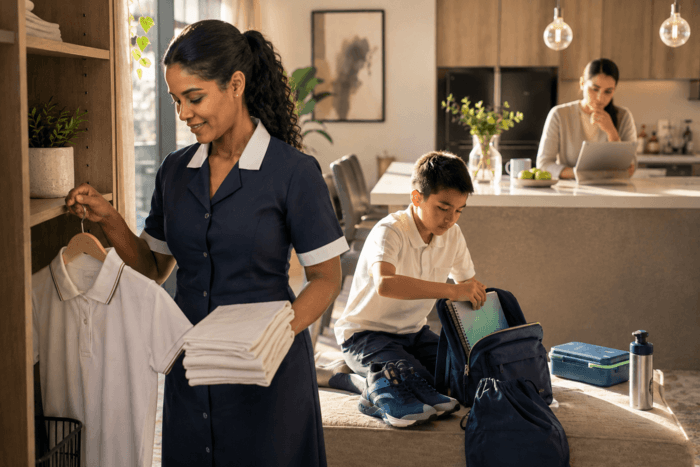
A successful school routine is rarely the work of one person.
Parents make the important decisions. Children gradually learn responsibility. The maid supports the practical household systems that keep the week moving.
Problems often begin when these roles are unclear.
If everyone assumes someone else packed the activity bag, checked the lunch box, or prepared the PE kit, small tasks are easily missed.
A simple division of responsibilities creates accountability without making the household rigid.
👨👩👧 Parents Lead the System
Parents should remain responsible for decisions involving:
- School communication.
- Children's health and wellbeing.
- Academic progress.
- Transport arrangements.
- Food and dietary decisions.
- Sleep schedules.
- Activity choices.
- Important calendar changes.
- Expectations for children's responsibilities.
- Instructions given to the maid.
The maid can support these decisions, but she should not have to guess what the family wants.
🧒 Children Participate According to Their Age
Children should gradually take responsibility for their own school life.
Their role may include:
- Returning bags and shoes to their places.
- Taking lunch boxes to the kitchen.
- Putting uniforms into the laundry system.
- Checking timetables.
- Packing age-appropriate school items.
- Managing homework.
- Remembering activity requirements.
- Informing parents about school notices.
The level of responsibility should increase as the child becomes more capable.
🧹 The Maid Keeps the Practical System Moving
The maid can connect many of the household tasks surrounding school.
Her role may include:
- Laundry and ironing.
- Uniform preparation.
- Breakfast and lunch support.
- Cleaning lunch boxes and bottles.
- Maintaining school storage areas.
- Preparing agreed activity items.
- Keeping children's spaces organised.
- Resetting the kitchen.
- Supporting younger children with agreed practical tasks.
- Preparing the household for the following day.
For families considering a new domestic worker, reviewing candidate profiles can help identify candidates whose previous experience better matches the household's priorities, whether those priorities include general household organisation, cooking, or experience working with families with children.
📊 Who Should Do What?
| School Routine | Parent | Child | Maid |
|---|---|---|---|
| School calendar | Manage | Learn to check | Follow relevant practical information |
| Uniform requirements | Decide / purchase | Wear and return correctly | Wash, iron, organise |
| School bag | Supervise by age | Increasing responsibility | Maintain surrounding system |
| Breakfast | Decide routine | Eat / participate | Prepare as agreed |
| Lunch | Decide food plan | Carry / return box | Prepare, pack, clean as agreed |
| Water bottle | Set requirements | Carry / return | Clean and prepare |
| Homework | Supervise | Complete | Prepare suitable environment |
| School notices | Read / respond | Deliver | Place noticed papers in agreed area |
| PE kit | Track requirements | Remember by age | Wash and prepare |
| Activities | Schedule | Participate / prepare by age | Support equipment and clothing preparation |
| Sleep routine | Manage | Follow | Support evening household preparation |
| After-school reset | Supervise system | Participate | Clean and reorganise |
| Next-day preparation | Check important changes | Prepare own items by age | Complete household support tasks |
The table should be adapted to each family.
The important point is that support and responsibility can exist together.
🗓️ The Ultimate Weekly Back-to-School Planner
A weekly planner turns individual tasks into a visible routine.
For UAE families, the regular school week runs from Monday to Friday, making Sunday an ideal day for the final weekly reset.
The planner does not need to contain every detail of family life.
It should focus on information that affects preparation.
📅 Monday-to-Friday Family Planner
| Day | Uniform | Lunch | School Bag | PE / Special Items | After-School Activity | Maid's Preparation |
|---|---|---|---|---|---|---|
| Monday | Check Sunday night | Planned Sunday | Child checks | Check schedule | Add if needed | Finalise breakfast, lunch, uniform and household preparation |
| Tuesday | Prepare Monday evening | Follow meal plan | Child checks | PE if scheduled | Add activity | Wash/reset Monday items and prepare Tuesday requirements |
| Wednesday | Prepare Tuesday evening | Follow meal plan | Child checks | Swimming / special items if required | Add activity | Prepare required clothing, food items, bottles and equipment |
| Thursday | Prepare Wednesday evening | Follow meal plan | Child checks | Check school calendar | Add activity | Reset used items and prepare Thursday needs |
| Friday | Prepare Thursday evening | Follow meal plan | Child checks | Friday requirements | Family schedule | Complete Friday preparation and identify weekend reset needs |
📝 Add a "Special This Week" Section
Not every school week is identical.
Create a small area for unusual requirements:
THIS WEEK
- Monday: Library book due.
- Tuesday: PE.
- Wednesday: Swimming.
- Thursday: School event.
- Friday: Early finish.
Parents update this section.
Children learn to check it.
The maid uses relevant information to plan practical preparation.
📌 Keep the Planner Where People Actually See It
A beautiful planner hidden inside a drawer does not help.
Place it somewhere appropriate and visible to the household, such as:
- Family command station.
- Kitchen notice area.
- Inside a frequently used cabinet.
- Household planning board.
A digital family calendar can also work.
The best system is the one the family will actually maintain.
🔄 Don't Rebuild the Planner Every Week
Most school weeks contain repeating routines.
Create a standard template and change only what is different.
For example:
PE every Tuesday → permanent
Swimming every Wednesday → permanent
School trip this Thursday → add this week
This reduces planning work for both parents and the maid.
✅ Ultimate Back-to-School Checklist for UAE Families
A good checklist should tell you what to do and when to do it.
Instead of one enormous list, divide preparation into stages.
📅 Two Weeks Before School
- Review the school calendar.
- Confirm the first school day and timings.
- Check transport arrangements.
- Review uniforms.
- Check school shoes.
- Inspect PE and activity clothing.
- Check school bags.
- Inspect lunch boxes and bottles.
- Review school supplies.
- Begin adjusting sleep schedules.
- Decide where school items will be stored.
- Explain the upcoming routine to the maid.
How the maid helps: Gather, wash, clean, sort, and organise existing school-related household items so parents can identify what needs replacing.
📅 One Week Before School
- Move bedtime closer to the school schedule.
- Begin school-time wake-ups.
- Complete uniform purchases.
- Label belongings where required.
- Create the family school station.
- Prepare the weekly calendar.
- Plan breakfasts.
- Plan school lunches.
- Check activity schedules.
- Organise homework space.
- Confirm each child's practical requirements.
How the maid helps: Organise uniforms and wardrobes, prepare kitchen and food-storage areas, clean school equipment, arrange household storage, and learn the weekly routine.
🌙 The Night Before the First Day
- Check the correct uniform.
- Prepare shoes.
- Check the school bag.
- Prepare required school items.
- Clean and prepare water bottles.
- Prepare lunch equipment.
- Check breakfast ingredients.
- Review transport timing.
- Confirm any special school requirement.
- Aim for an appropriate bedtime.
How the maid helps: Prepare the uniform, reset the kitchen, organise agreed food items, ensure lunch equipment is clean, and place household-prepared items where they belong.
🌅 Every School Morning
- Wake up on time.
- Get dressed.
- Eat breakfast.
- Finalise lunch.
- Prepare water.
- Complete the bag check.
- Check special activity items.
- Put on shoes.
- Leave with a time buffer.
How the maid helps: Prepare breakfast and agreed lunch items, keep uniforms and bottles ready, support younger children where agreed, and keep practical household tasks moving.
🚌 Every Afternoon
- Return bags to their place.
- Put shoes away.
- Take lunch boxes to the kitchen.
- Return water bottles.
- Change out of school clothing.
- Put dirty uniforms into the laundry system.
- Eat or have a snack.
- Rest as appropriate.
- Begin homework or activities.
- Check school papers.
How the maid helps: Clean lunch equipment, begin uniform laundry, prepare food, maintain household organisation, and reset school-related items.
🌙 Every Evening
- Check tomorrow's timetable.
- Confirm PE or activity requirements.
- Prepare the correct uniform.
- Reset activity bags.
- Check lunch ingredients.
- Prepare breakfast essentials.
- Organise school station.
- Complete homework.
- Wind down for bedtime.
How the maid helps: Complete required laundry and ironing, prepare clothing, organise food and kitchen items, reset activity equipment, and prepare the household for morning.
🔄 Every Weekend
- Review next week's calendar.
- Complete uniform laundry.
- Check school supplies.
- Restock lunch ingredients.
- Clean school equipment.
- Review activity requirements.
- Deal with accumulated papers.
- Reset children's rooms.
- Update unusual events for the coming week.
How the maid helps: Complete the household reset while parents review schedules, school requirements, and decisions for the coming week.
✅ THE CHECKLIST TEST
If Monday morning still requires remembering ten things from scratch, the system needs improvement.
A good checklist moves as many decisions as possible out of the morning rush.
🆘 Build a Back-to-School Backup Kit
Even organised families forget things.
Water bottles break. Socks disappear. A pencil case gets left at school. A lunch box goes missing. A child suddenly remembers that an extra item is needed.
A small backup system can prevent minor problems from becoming major morning disruptions.
🎒 What Could the Backup Kit Include?
Depending on the child's school requirements, consider keeping spare:
- Basic stationery.
- Name labels.
- Water bottle.
- Lunch container.
- Socks.
- Hair accessories where needed.
- Common school supplies.
- Frequently required activity items where practical.
There is no need to duplicate everything the child owns.
Focus on inexpensive items that are frequently forgotten, lost, or needed at short notice.
📦 Where Should It Be Kept?
Keep backup supplies in one designated location.
Do not scatter them across several cupboards.
The maid should know where the backup items are kept, but children should also know that the kit is an emergency resource rather than an excuse not to look after their belongings.
🧹 How Can the Maid Maintain It?
The maid can help notice when household backup supplies have been used or are running low.
She can then inform the parents.
Parents decide what needs replacing.
This creates a simple cycle:
FORGOT / LOST
↓
USE BACKUP
↓
TELL PARENT
↓
REPLACE
↓
BACKUP READY AGAIN
🆘 BACKUP RULE
Build backups for predictable small problems—not for every possible problem.
⚠️ Common Back-to-School Routine Mistakes
A school routine does not need to be perfect.
But certain mistakes repeatedly create unnecessary pressure.
❌ Waiting Until Sunday Night to Prepare Everything
Trying to check uniforms, find school supplies, plan lunches, reset bedtime, and organise bags in one evening creates stress before school has even begun.
Better approach: Spread preparation across the previous one to two weeks, with Sunday used for the final reset.
❌ Preparing Too Much in the Morning
If uniforms, lunch equipment, PE kits, and school bags are all dealt with after waking up, even a small delay can disrupt the entire routine.
Better approach: Move everything that can reasonably be prepared to the previous evening.
The maid can play a major role here by completing agreed household preparation before bedtime.
❌ Having No Fixed Place for School Items
If bags, shoes, bottles, and activity equipment move around the house every day, time will be lost searching for them.
Better approach: Give frequently used items a home.
The maid helps maintain the station; children learn to return their belongings.
❌ Leaving Uniform Laundry Until the Last Minute
A uniform does not become urgent because it is dirty.
It becomes urgent because it is needed tomorrow.
Better approach: Let the maid organise school laundry according to the weekly calendar.
❌ Expecting the Maid to Remember the Entire School Calendar
Even a highly organised maid cannot be expected to know about a school event that nobody told her about.
Better approach: Parents manage the calendar and communicate practical changes clearly.
❌ Giving the Maid Instructions from Several People
One parent says one thing.
Another says something different.
An older child adds another request.
The result can be confusion.
Better approach: Establish clear household priorities and make sure instructions do not conflict.
❌ Doing Everything for Children
An extremely efficient household can accidentally create children who never need to remember anything themselves.
Better approach: Increase age-appropriate responsibility gradually.
The maid supports the system without automatically becoming responsible for every child's belongings.
❌ Treating the Maid as Both Full-Time Housekeeper and Full-Time Childcare Provider at the Same Moment
Household work and direct childcare can compete for attention.
Better approach: Prioritise responsibilities realistically, especially during periods when younger children require supervision.
❌ Creating a Routine Too Complicated to Maintain
Colour-coded charts, multiple baskets, apps, checklists, and detailed schedules can look impressive.
But if the system requires constant management, the family may abandon it within two weeks.
Better approach: Use the simplest system that solves the problem.
⚠️ BACK-TO-SCHOOL REALITY CHECK
A routine is only successful if your family and maid can still follow it on an ordinary, busy Wednesday—not just during the carefully organised first week of school.
🔄 When the School Routine Isn't Working: Fix the System
Even a carefully planned back-to-school routine may need adjustment once the real school week begins.
The first few days reveal things a checklist cannot always predict.
Breakfast may take longer than expected. One child may need more time to get ready. Lunch preparation may interfere with another morning task. The maid may have too many responsibilities during the same 30-minute period. An after-school activity may make Tuesday evenings much busier than the rest of the week.
That does not mean the entire routine has failed.
It means you have found a bottleneck.
🔍 Identify the Repeating Problem
Do not redesign the whole routine because of one difficult morning.
Instead, look for problems that repeat.
For example:
- Uniforms are regularly not ready on time.
- Children cannot find their shoes.
- Lunch preparation takes too long.
- The maid receives several urgent requests at once.
- Activity equipment is repeatedly forgotten.
- Children go to bed later because preparation starts too late.
- School papers are not reaching parents.
- One child consistently needs more morning time.
Then ask:
What is actually causing this problem?
If uniforms are not ready, the solution may not be "wash faster."
The problem may be that the laundry schedule does not account for PE days.
🧹 Review the Maid's Workload
If several school-related tasks are repeatedly unfinished, review when they are being assigned.
The maid may be expected to prepare breakfast, pack lunches, assist a younger child, finish ironing, clean the kitchen, and complete regular household cleaning during the same period.
The solution may simply be to move non-urgent tasks.
For example:
Before school: Time-sensitive family support.
After departure: Regular cleaning and household work.
Afternoon: After-school reset and normal duties.
Evening: Essential preparation for tomorrow.
Prioritisation is more effective than repeatedly adding new tasks.
🔧 Change One Thing at a Time
When possible, fix the main problem first.
If mornings are delayed because shoes keep disappearing:
Problem: Shoes cannot be found.
↓
Cause: No consistent return location.
↓
Change: Create one school-shoe area.
↓
Maid's role: Keep the area organised.
↓
Child's role: Return shoes after school.
↓
Test: Does the problem disappear?
This makes it easier to know whether the change worked.
🧒 Adjust the Routine to the Child
Not every child needs the same amount of time or support.
One child may dress independently in five minutes.
Another may need reminders and more time.
A teenager may manage almost the entire routine independently, while a younger child requires close parental support.
The maid's assistance should also reflect these differences.
She may provide more practical support to a younger child while simply ensuring that an older child's clean uniform and household-prepared items are available.
🔄 Use a Simple Fix-the-Routine Framework
WHAT WENT WRONG?
↓
WHY DID IT HAPPEN?
↓
WHO OR WHAT NEEDS TO CHANGE?
↓
CHANGE ONE THING
↓
TEST IT FOR A FEW DAYS
↓
KEEP OR ADJUST
🔧 DON'T BLAME THE PERSON BEFORE CHECKING THE SYSTEM
Repeated problems are sometimes caused by unclear instructions, conflicting priorities, poor storage, or unrealistic timing. Fixing the system may solve the problem more effectively than simply telling someone to "remember next time."
📆 The Sunday Reset: Prepare the Whole School Week
For UAE families following the Monday-to-Friday school week, Sunday is the natural point to make sure the household is ready for Monday.
This does not need to become a long weekly project.
A focused reset can prevent dozens of small problems during the next five days.
📅 Review the Week Ahead
Parents should check:
- School calendar.
- PE days.
- Swimming.
- Clubs.
- Sports.
- School events.
- Trips.
- Early finishes.
- Special clothing.
- Transport changes.
- Unusual lunch requirements.
Then share relevant practical information with the maid.
A short Sunday conversation can be enough:
"Tuesday is PE, Wednesday is swimming, and Thursday we need to leave earlier."
Now she can plan household preparation around the real week.
👕 Check the Uniform Supply
By Sunday, the maid can make sure:
- Regular uniforms are clean.
- Essential items are ironed.
- PE kits are available.
- Activity clothing is ready.
- Socks and accessories are organised.
- Monday's uniform is prepared.
Any missing or damaged items can be reported before Monday morning.
🍎 Review School Food
Parents can confirm the general lunch and breakfast plan.
The maid can then:
- Check available ingredients.
- Organise approved snacks.
- Prepare suitable ingredients in advance.
- Clean and organise lunch equipment.
- Make sure bottles are ready.
- Identify anything that needs purchasing.
🎒 Reset School and Activity Equipment
Sunday is also a good time to check:
- School bags.
- PE bags.
- Swimming equipment.
- Sports bags.
- Frequently used school supplies.
- Homework station.
- School command station.
The maid can clean and organise these areas while children check their personal belongings.
⏱️ The 30-Minute Sunday Reset
A simple framework:
10 MINUTES — CALENDAR
Parents review the coming week and tell the household what is different.
↓
10 MINUTES — UNIFORMS & EQUIPMENT
Children check personal requirements while the maid confirms that household-prepared clothing and equipment are ready.
↓
10 MINUTES — FOOD & HOME
Parents confirm meal requirements while the maid checks kitchen supplies, lunch equipment, and practical preparation.
The reset does not literally need to finish within 30 minutes.
The framework simply keeps preparation focused.
📆 SUNDAY RESET RULE
Don't try to prepare every detail for all five school days. Prepare the system, identify unusual requirements, and make Monday completely ready.
🌟 What Should a Well-Organised School Week Feel Like?
The goal of back-to-school organisation is not a home where nothing ever goes wrong.
Children will forget things.
Schedules will change.
Traffic will happen.
Someone will wake up late.
A school may send a last-minute notice.
The real goal is to make ordinary days easier and unexpected days more manageable.
🌅 Mornings Feel More Predictable
A successful routine means fewer questions such as:
"Where are my shoes?"
"Is my PE shirt clean?"
"Where is my water bottle?"
"What are we having for lunch?"
The answers already exist within the system.
🎒 Fewer Items Are Forgotten
A school station, evening preparation, and final door check cannot prevent every forgotten item.
But they significantly reduce the number of things that depend entirely on memory.
The maid contributes by ensuring household-prepared items return to their designated places.
Children contribute by learning to check their own belongings.
Parents supervise the overall process.
🍎 Meals Become More Predictable
Breakfast and school lunches are easier when basic decisions have already been made.
The maid does not need to ask what to prepare every morning if the family has provided a clear plan.
Parents still control food decisions.
The practical preparation simply becomes more consistent.
👕 Uniform Emergencies Become Unusual
With a school-aware laundry system, the maid knows which items are time-sensitive.
PE clothing does not remain forgotten in the laundry until the morning it is needed.
Uniform preparation becomes a routine rather than an emergency.
🧒 Children Become More Independent
An organised household should not make children less responsible.
Over time, the opposite should happen.
Because there is a clear system, children can learn exactly what they are expected to do.
They know:
- Where the bag belongs.
- Where the lunch box goes.
- Where dirty uniforms go.
- How to check tomorrow's schedule.
- Which belongings they are responsible for.
The maid supports the structure without removing these learning opportunities.
🧹 The Maid's Work Becomes More Organised Too
Clear routines benefit the domestic worker as well.
Instead of receiving unpredictable instructions throughout the day, she understands:
- Which tasks are time-sensitive.
- Which uniforms are needed.
- When activities occur.
- What food preparation is expected.
- Where school items belong.
- What needs to happen before morning.
- Which tasks can wait until quieter periods.
Clear expectations make it easier to organise the workload realistically.
🔄 The Sustainable School-Week Formula
PREPARE
↓
ORGANISE
↓
SHARE RESPONSIBILITIES
↓
RESET DAILY
↓
REVIEW WEEKLY
↓
ADJUST WHEN NEEDED
↓
REPEAT
A strong routine should eventually require less thinking, not more.
❓ Frequently Asked Questions
-
How can a maid help during the back-to-school season?
A maid can support the family by preparing and organising school uniforms, assisting with breakfast and planned school lunches, cleaning lunch boxes and bottles, maintaining children's spaces, organising school-related household items, preparing activity clothing, and helping reset the home for the following day. Parents should still manage school decisions, children's wellbeing, education, schedules, and overall family routines.
-
What should a maid prepare the night before school?
Depending on the family's arrangements, the maid can prepare the correct clean and ironed uniform, make sure lunch boxes and bottles are clean, organise breakfast ingredients, prepare suitable lunch ingredients, reset the kitchen, and make sure PE or activity clothing is available. Children should also prepare age-appropriate personal school items rather than expecting the maid to manage everything.
-
Can a maid prepare children's school lunches?
Yes, school-lunch preparation can form part of agreed household duties. Parents should decide the child's food plan and provide clear instructions about allergies, dietary requirements, school restrictions, and suitable foods. The maid can then help prepare ingredients, pack agreed meals, organise snacks, clean containers, and maintain the lunch-preparation area.
-
Should a maid pack a child's school bag?
That depends on the child's age and the family's arrangement. Younger children may need more assistance, while older children should gradually become responsible for checking timetables, packing books, managing homework, and remembering personal school items. A maid can keep the surrounding system organised and provide appropriate support without automatically taking complete responsibility for the bag.
-
How can a maid help with school uniforms?
A maid can wash, dry, iron, organise, and prepare school uniforms according to the child's weekly schedule. She can also help keep PE kits and activity clothing ready. Parents should make sure she knows which uniform is required on each day and inform her about unusual school events or schedule changes.
-
How can families make school mornings less stressful?
Prepare as much as possible the night before. Keep bags, shoes, lunch equipment, and activity items in fixed places. Use a simple morning sequence, allow a small time buffer, and divide responsibilities clearly between parents, children, and the maid. If the same delay happens repeatedly, adjust the system rather than simply trying to move faster.
-
What should families prepare one week before school starts?
Families should check uniforms, shoes, bags, lunch boxes, bottles, school supplies, transport arrangements, activity schedules, homework areas, and the family calendar. Sleep and wake-up times can also begin moving toward the school routine. The maid can help by washing, cleaning, sorting, and organising household and school-related items before the first day.
-
How can a maid help with after-school activities?
She can prepare clean sports or activity clothing, organise agreed equipment, prepare snacks and water according to parental instructions, and reset washable items after the child returns. Keeping each recurring activity in a dedicated bag or storage area can make this support much easier.
-
Should a maid help children with homework?
A maid can support the homework environment by keeping the study area clean, organising general supplies, preparing a snack or water, and reducing practical household interruptions. Academic teaching, homework completion, school performance, and communication with teachers should remain under parental responsibility unless a separate appropriate childcare or educational arrangement exists.
-
How should parents divide school responsibilities between children and a maid?
Parents should manage decisions and supervision, children should take increasing responsibility for their personal belongings and schoolwork according to age, and the maid should support practical household tasks such as uniforms, meals, laundry, organisation, and agreed routines. The aim is to make family life easier without preventing children from developing independence.
-
How do you create a weekly school routine at home?
Start with the Monday-to-Friday school calendar and add PE days, activities, transport changes, special events, and meal requirements. Then identify which tasks must happen the night before, which belong to the child, and which household tasks the maid will support. Use Sunday for a short weekly reset and complete a smaller reset after every school day.
-
What should families do if the new school routine is not working?
Identify the specific recurring problem before changing the entire routine. Check whether the cause is timing, unclear responsibilities, missing information, poor organisation, or an unrealistic workload. Adjust one major issue, test the change for several days, and review the routine again. Parents should also make sure the maid understands any changes affecting her responsibilities.
📞 A Well-Prepared Home Makes Back to School Easier
Going back to school changes much more than children's schedules.
It changes when the family wakes up, eats, uses the kitchen, handles laundry, prepares clothing, organises activities, completes homework, and gets ready for the following day.
The solution is not expecting parents, children, or the maid to remember everything.
It is building a household system in which everyone understands their role.
Parents lead and make the important decisions.
Children gradually learn to manage their own school responsibilities.
A well-organised maid supports the practical work that surrounds those responsibilities—from uniforms and meals to laundry, school equipment, household organisation, and next-day preparation.
When these roles work together, mornings can become calmer, fewer items are forgotten, evening preparation becomes easier, and parents have more time to focus on their children instead of constantly solving small household emergencies.
Ezee Workers Employment Services Center helps UAE families find suitable domestic workers for their household needs and provides support throughout the hiring journey.
If your family is preparing for the new school year and needs reliable household support, contact us to discuss your requirements and find the right domestic worker for your family.