A maid's profile can tell you where she has worked, how many years of experience she has, which languages she speaks, and the household skills she says she can perform.
But it cannot tell you everything you need to know before inviting someone to live and work in your home.
How clearly does she communicate? Can she explain what she actually did for previous families? Does her experience match the responsibilities you need help with? Does she understand your expectations? And just as importantly, does she feel that your household and the role are suitable for her?
That is why the interview is one of the most important stages of the hiring process.
A successful maid interview should evaluate experience, practical skills, communication, expectations, and compatibility with your household rather than simply collecting a series of "yes" or "no" answers.
For families planning to hire a maid in Dubai, the interview is also an opportunity to identify potential misunderstandings before employment begins. Both sides should leave the conversation with a realistic picture of the job.
This guide takes you through the complete interview process—from preparation and asking better questions to recognising positive signs, identifying warning signs, comparing candidates, and making the final decision.
🎯 The 5-Part Maid Interview
EXPERIENCE
↓
SKILLS
↓
COMMUNICATION
↓
EXPECTATIONS
↓
FAMILY FIT
The goal is not to find a candidate who gives a perfect answer to every question.
It is to find the candidate whose experience, abilities, expectations, and working style best match what your family genuinely needs.
🗣️ Why Is the Maid Interview So Important?
Hiring someone based only on a CV can leave important questions unanswered.
Two candidates may appear almost identical on paper but communicate very differently during an interview. Another candidate may have fewer years of experience but much stronger experience in exactly the area your household needs.
The interview adds context to the information already available.
It helps turn a candidate profile into a clearer picture of the person behind it.
📄 What a CV Can Tell You—and What It Cannot
Before the interview, families can usually review information such as:
- Previous employment.
- Countries where the candidate has worked.
- Years of experience.
- Languages spoken.
- Cleaning experience.
- Cooking skills.
- Childcare experience.
- Other stated household abilities.
This information is valuable, but it is only the starting point.
For example, a profile may say "childcare experience."
That description alone does not tell you:
- How old the children were.
- How many children she cared for.
- Whether childcare was her main responsibility.
- Whether a parent was usually present.
- Which child-related tasks she performed.
- How long she performed those duties.
The interview allows you to explore those details.
The same applies to cooking.
"Can cook" could mean preparing several complete family meals independently, or it could mean assisting with basic food preparation under instruction.
Neither answer is automatically good or bad.
What matters is whether the candidate's actual ability matches what your household expects.
Families can review available maid profiles before interviewing and use the information in each profile as a starting point for deciding what they need to verify during the conversation.

🧩 The Interview Is About Compatibility, Not Finding a "Perfect" Maid
There is no single candidate who is ideal for every household.
Consider three different families:
Family A has two young children and needs strong childcare support.
Family B has teenagers and mainly needs cleaning, laundry, and household organisation.
Family C enjoys home-cooked meals and wants someone comfortable preparing food regularly.
A candidate with excellent cooking and cleaning skills may be a great match for Family C but not necessarily for Family A.
Another candidate with extensive experience caring for toddlers may be ideal for Family A even if her cooking skills are basic.
That is why an interview should not become a competition to find the maid with the longest list of skills.
The real question is:
Does this candidate have the right strengths for our household?
💡 INTERVIEW PRINCIPLE
The purpose of an interview is not to find someone who says "yes" to everything. It is to discover whether what your family needs and what the candidate can realistically provide are a good match.
🤝 Preventing Mismatched Expectations Before Employment Begins
Many employment problems begin with expectations that were never clearly discussed.
A family may assume that cooking is part of the role.
The candidate may believe she will mainly be cleaning.
Parents may expect regular childcare.
The candidate may have only occasional experience helping with children.
These differences are much easier to discover during an interview than after employment has begun.
Important areas to clarify can include:
- Main household duties.
- Number and ages of children.
- Childcare expectations.
- Cooking requirements.
- Size and type of home.
- Pets.
- Household routines.
- Skills that are particularly important.
- Areas where training may be provided.
- Any relevant special requirements.
A clear interview protects both sides from making decisions based on assumptions.
📝 How Should You Prepare Before Interviewing a Maid?
A good interview begins before the call or meeting starts.
Interviewing without preparation often leads to random questions. Families remember important points only after the conversation ends, and different candidates may be asked completely different things, making comparison difficult.
A simple preparation process produces much better information.
🎯 Define Your Family's Real Needs First
Before evaluating a candidate, evaluate your own household.
Ask:
What do we actually need help with?
Separate your requirements into three categories.
🔴 Must Have
These are requirements that genuinely affect whether the candidate can perform the role.
Examples might include:
- Experience with young children.
- Ability to communicate in a language used by the family.
- Confidence with the main household duties.
- Experience in a large home if the workload requires it.
- Comfort working in a home with pets when relevant.
🟡 Important
These skills would make household life easier but may not be essential.
Examples could include:
- Cooking certain types of meals.
- Strong ironing skills.
- Previous UAE or Gulf experience.
- Experience organising wardrobes.
- Ability to assist with school routines.
🟢 Nice to Have
These are useful additional strengths but should not distract you from the skills the role genuinely requires.
For example, excellent baking ability may sound attractive, but it should not outweigh strong childcare experience if caring for young children is your family's main priority.
This simple exercise prevents families from being impressed by skills that have little relevance to their actual needs.
📋 Review the Candidate's Profile Before the Interview
Do not spend the first ten minutes asking the candidate to repeat information already available in her profile.
Review it beforehand.
Pay particular attention to:
- Previous employers.
- Length of previous employment.
- Countries where she has worked.
- Household experience.
- Children's ages where available.
- Cooking experience.
- Languages.
- Listed skills.
- Any employment gaps or unclear information.
- Any experience directly related to your priorities.
Highlight anything you want to understand better.
If the candidate has five years of childcare experience, for example, the interview should explore what those five years actually involved, rather than simply asking whether she has childcare experience.
🔍 Know What You Want to Verify
Think of the candidate profile as the first layer of information.
The interview is the second.
Instead of asking:
"Have you worked as a maid before?"
when the profile already shows several previous jobs, explore the information behind that statement.
You might want to understand:
- What her normal day looked like.
- Which tasks she performed independently.
- Which responsibilities were most important.
- What she enjoyed doing.
- Which tasks she found challenging.
- Whether her previous household resembled yours.
This approach makes the interview a conversation about real experience rather than a repetition of the CV.
📊 Prepare a Simple Interview Scorecard
Memory is unreliable, especially when interviewing several candidates.
A simple scorecard allows you to evaluate everyone against the same household priorities.
| Area | What You Need to Evaluate |
|---|---|
| Experience | Is it relevant and clearly explained? |
| Household skills | Do they match your main needs? |
| Childcare | Does she have suitable age-specific experience if required? |
| Cooking | What can she genuinely prepare? |
| Communication | Can both sides understand each other effectively? |
| Expectations | Does she understand the role? |
| Attitude | Is she open, realistic, and professional? |
| Overall fit | Does the combination suit your household? |
You do not need a complicated scoring system.
The purpose is simply to prevent one impressive answer or one awkward moment from dominating your entire decision.
👨👩👧 Decide Who Should Attend the Interview
More interviewers do not necessarily produce a better interview.
If both parents will regularly communicate with the maid, it may be useful for both to participate.
However, avoid creating a situation where several family members question the candidate simultaneously.
This can make the interview stressful and make it harder to assess natural communication.
Children also do not necessarily need to attend the entire conversation.
If childcare is an important part of the role, there may be value in introducing them at an appropriate stage, particularly during a later interview.
📋 Before You Call: The 5-Step Preparation
1. FAMILY NEEDS
What matters most in your household?
↓
2. CANDIDATE PROFILE
What do you already know?
↓
3. INFORMATION GAPS
What needs clarification?
↓
4. CORE QUESTIONS
What will help you verify suitability?
↓
5. SCORECARD
How will you compare candidates fairly?
📌 PREPARATION TIP
Use the same core evaluation areas for every candidate. You can ask different follow-up questions, but a consistent framework makes your final comparison much more reliable.
🤝 How to Start a Maid Interview the Right Way

The first few minutes can influence the quality of the entire conversation.
A candidate who feels she is being rapidly tested may give short, cautious answers. A candidate who understands the purpose of the conversation is more likely to explain her experience naturally.
The interview should remain professional, but professional does not have to mean intimidating.
👋 Begin with a Friendly Introduction
Start by introducing yourself and briefly explaining what will happen.
You can tell the candidate that you would like to learn about her previous experience, discuss your family's needs, explain the role, and give her time to ask questions.
This immediately creates a clearer structure.
There is no need for a long introduction.
A calm beginning is enough.
🏠 Explain Your Family Before Asking Detailed Questions
The candidate cannot tell you whether she is suitable for a job she does not understand.
Give her the basic context first.
Relevant information might include:
- Number of adults in the household.
- Number of children.
- Children's ages.
- Type or approximate size of home.
- Whether you have pets.
- Main responsibilities.
- Whether cooking is important.
- Whether childcare is a significant part of the role.
If your household primarily needs cleaning and home organisation, say so.
If caring for young children will be a major responsibility, make that equally clear. Families whose main requirement is dedicated childcare should also consider whether hiring a nanny in Dubai may be more appropriate than selecting a candidate whose experience is mainly general household work.
🚫 Avoid Starting Like an Interrogation
Rapid questions often produce rapid answers.
For example:
"Can you clean?"
"Yes."
"Can you cook?"
"Yes."
"Can you look after children?"
"Yes."
After three questions, you have three positive answers—but almost no useful information.
Open the conversation first and then explore relevant areas naturally.
This gives you a much better opportunity to understand what the candidate has actually done.
⏳ Give the Candidate Time to Think
A pause is not automatically a warning sign.
The candidate may be:
- Nervous.
- Speaking in her second or third language.
- Trying to remember a specific example.
- Making sure she understood your question.
- Experiencing a delay during a video call.
Allow reasonable time for an answer.
If she appears confused, simplify or rephrase the question rather than immediately moving to the next one.
A maid interview is partly an assessment of communication, but communication is a two-way process.
How clearly you explain the question can influence the quality of the answer you receive.
❓ What Questions Should You Ask During a Maid Interview?
The best maid interview questions are not necessarily the most complicated ones.
They are the questions that help you understand whether the candidate's actual experience matches the responsibilities in your home.
You do not need to ask dozens of questions in one interview. Focus first on the areas that matter most to your family, then use follow-up questions whenever an answer needs more detail.
💼 Ask About Previous Experience
Previous employment is one of the best starting points because it allows the candidate to talk about situations she has actually experienced.
Rather than simply asking how many years she has worked, try to understand what those years involved.
Useful areas to explore include:
- Type and size of previous households.
- Number of family members.
- Ages of children she cared for.
- Main daily responsibilities.
- Cleaning and laundry duties.
- Cooking responsibilities.
- Length of time with previous employers.
- Tasks she performed independently.
A candidate who worked for five years in a home with two toddlers may have very different experience from someone who worked for the same period in a household with adults only.
The number of years matters, but the relevance of those years matters more.
🏠 Ask About the Tasks That Matter Most to Your Family
Do not spend equal time discussing every possible household skill.
If cooking is only an occasional requirement in your home, there is little value in using half the interview to discuss recipes.
If you have a newborn, however, relevant childcare experience deserves much greater attention.
Concentrate on your Must Have priorities from the preparation stage.
For example, your main areas might be:
- Childcare.
- Cleaning.
- Cooking.
- Laundry and ironing.
- Household organisation.
- Pet care.
- Support for elderly family members.
The interview should reflect the actual job.
🗣️ Use Open-Ended Questions Instead of Yes/No Questions
A yes/no question tells you whether a candidate is willing to claim a skill.
An open-ended question can tell you what that skill actually means.
Compare these examples:
Weak question:
"Can you cook?"
Better question:
"What meals did you usually prepare for your previous family?"
Or:
Weak question:
"Are you good at cleaning?"
Better question:
"How did you normally organise your cleaning tasks in your previous home?"
The second version encourages the candidate to describe real experience.
That gives you information you can evaluate.
🔎 Ask for Examples, Not Just Claims
Candidates naturally want to present themselves positively during an interview.
Statements such as "I am good with children" or "I can cook very well" are useful starting points, but they should not always be the end of the discussion.
Ask for an example.
If a candidate says she has strong childcare experience, you might ask her to describe the children she previously cared for and her normal responsibilities with them.
If she says she can cook, ask what she regularly prepared without assistance.
Real examples add context to general claims.
🧠 Use One or Two Realistic Scenario Questions

Scenario questions can help you understand how a candidate thinks when a situation does not have a simple yes/no answer.
For example, instead of asking whether she can manage competing household responsibilities, you might briefly describe a realistic situation where two tasks need attention and ask what she would prioritise.
The purpose is not to create trick questions.
You are observing:
- Whether she understands the situation.
- What she considers first.
- How she explains her decision.
- Whether she asks for clarification.
- How she communicates when there is no obvious answer.
One or two meaningful scenarios are usually more useful than a long sequence of hypothetical problems.
🎓 Ask Where She May Need Training
This question can reveal something very valuable: realism.
No candidate is likely to know every appliance, recipe, cleaning product, household system, or family routine she may encounter.
A candidate might be excellent at cleaning but unfamiliar with your coffee machine.
She may have strong childcare experience but never have prepared the particular meals your family prefers.
She may know how to iron well but have never used a steam wardrobe system.
These are not necessarily reasons to reject her.
Some skills can be learned.
A candidate who openly says, "I haven't done that before, but I can learn," may give you more useful information than someone who claims complete expertise in everything.
📌 REMEMBER
The quality of the answer often depends on the quality of the question. Ask fewer questions that encourage real examples instead of many questions that produce only "yes" or "no."
👀 What Should You Observe During the Interview?
An interview is not only about the questions you ask.
Pay attention to how the conversation develops.
This does not mean analysing every facial expression or trying to "read" someone's personality from body language. Such judgments can be unreliable, particularly when a candidate is nervous or communicating in another language.
Focus instead on observable, job-relevant behaviour.
👂 Does She Understand the Questions?
If communication is important in your household, test it naturally through conversation.
Asking:
"Do you speak English?"
may simply produce:
"Yes."
That tells you very little.
A 20- or 30-minute conversation gives you a much clearer picture of whether everyday communication is likely to work.
Consider:
- Does she understand ordinary instructions?
- Does she follow the conversation?
- Can she explain her previous responsibilities?
- Does she ask when something is unclear?
- Can you understand her responses without repeatedly guessing?
Perfect grammar is not necessary.
Effective communication is.
💬 Does She Give Specific or Generic Answers?
Specific answers often provide stronger evidence of genuine experience.
Compare:
Generic:
"I took care of children."
with:
Specific:
"I looked after two children aged three and six. I prepared breakfast, helped the older child get ready for school, organised their clothes, and stayed with the younger child during the day."
The second answer gives you details that can be explored further.
Look for examples, routines, ages, tasks, and situations rather than polished phrases alone.
📄 Is Her Experience Consistent with Her Profile?
The interview gives you an opportunity to verify information already presented in the candidate's profile.
Small differences do not automatically mean something is wrong.
Dates may be remembered approximately. A profile may summarise a complicated job in one sentence. Language differences can also cause misunderstandings.
However, significant inconsistencies deserve clarification.
If the profile describes extensive childcare experience but the candidate cannot explain any childcare responsibilities, ask follow-up questions.
Do not immediately accuse.
Clarify first.
🤝 How Does She Describe Previous Employers?
Previous employment can naturally include both positive and difficult experiences.
The important issue is not whether every previous job was perfect.
Listen to how the candidate explains those experiences.
Can she describe a disagreement or challenge without turning the entire conversation into complaints?
Can she explain why a job ended?
Does her explanation remain reasonably consistent?
Professional communication about previous employment can be informative, while remembering that you are hearing only one side of the story.
👂 Does She Listen Before Answering?
Good communication is not just about speaking confidently.
Listening matters too.
A candidate who pauses to understand the question, asks for clarification when needed, or checks that she understood a responsibility correctly may demonstrate stronger practical communication than someone who answers immediately without understanding.
In a household, instructions will not always be perfectly simple.
The ability to clarify can prevent mistakes later.
🙋 Is She Comfortable Saying "I Don't Know"?
This can actually be a positive sign.
If you ask about an appliance, recipe, childcare routine, or cleaning method she has never used, an honest answer provides useful information.
You can then decide whether that skill can be taught.
Be more cautious when a candidate claims expertise in virtually everything but struggles to provide examples.
👁️ Listen Beyond the Answer
During the interview, consider four things together:
WHAT SHE SAYS
Does the answer address the question?
↓
HOW SHE EXPLAINS IT
Can she provide useful details?
↓
IS IT CONSISTENT?
Does it fit her profile and other answers?
↓
DO YOU UNDERSTAND EACH OTHER?
Can communication work in everyday household situations?
The combination is more useful than judging any single answer in isolation.
🟢 Positive Signs During a Maid Interview
A good interview does not require flawless answers.
Positive signs are usually patterns that suggest the candidate understands the role, communicates realistically, and can support the needs that matter most to your household.
🟢 Clear and Specific Answers
Candidates with relevant experience can often describe what they actually did.
They may remember:
- Children's ages.
- Types of meals they prepared.
- How they organised cleaning.
- Their main daily responsibilities.
- How many people lived in the household.
- Tasks they performed regularly.
Details do not guarantee suitability, but they give you stronger information to evaluate.
🟢 Real Examples from Previous Work
A strong candidate does not rely only on phrases such as:
"I am hardworking."
"I love children."
"I am very good at cleaning."
She can usually connect those statements to actual experience.
Examples allow you to understand what the candidate means when she describes a skill.
🟢 Honest About Skills and Limitations
No maid is equally experienced in every domestic task.
Honesty about limitations can therefore be a positive sign.
For example:
"I can cook Filipino and basic Arabic food, but I haven't cooked Indian food before."
This answer gives the family something useful to work with.
You can decide whether the existing skills are sufficient and whether additional recipes can be taught.
Realistic self-assessment is often more valuable than promising to do everything.
🟢 Asks Relevant Questions About the Job
The interview is an important decision for the candidate too.
Questions about the children, main responsibilities, cooking expectations, household size, daily routine, or other relevant working arrangements may indicate that she is trying to understand the position properly.
A candidate who wants clarity is not necessarily being difficult.
She may simply be trying to avoid accepting a role she does not understand.
🟢 Seeks Clarification When Needed
If the candidate does not understand a question, asking you to repeat or explain it can be a positive communication behaviour.
In everyday household life, misunderstandings will happen.
Someone who is comfortable asking for clarification may be less likely to pretend she understands an instruction when she does not.
🟢 Shows Realistic Expectations
A productive interview should gradually create a realistic picture for both sides.
Positive signs include a candidate who listens carefully when you explain the role, responds openly to the responsibilities, and raises questions where expectations need clarification.
🟢 Experience Matches Your Priority Needs
This is ultimately one of the strongest positive signs.
A candidate does not need to have every possible domestic skill if her strongest abilities match your most important requirements.
If your main need is general household support, a candidate with solid cleaning, laundry, organisation, and relevant home-management experience may be a stronger fit than someone whose experience is primarily childcare.
Families seeking consistent household assistance can also explore the role of a live-in maid and consider whether this type of support matches their long-term household routine.
🟢 Communicates Respectfully
Respect should work in both directions.
A calm, professional conversation where both sides listen, explain, and clarify creates a much better foundation than an interview focused only on testing the candidate.
🟢 Positive-Sign Cards
SPECIFIC
Gives real examples.
CONSISTENT
Answers broadly align with her profile and previous explanations.
CURIOUS
Asks sensible questions about the role.
REALISTIC
Does not claim to be perfect at everything.
COMMUNICATIVE
Clarifies what she does not understand.
RELEVANT
Her strongest skills match your priorities.
🚩 Warning Signs During a Maid Interview
Warning signs deserve attention, but they should be evaluated carefully.
One nervous answer should not automatically eliminate a candidate.
Look for meaningful patterns, serious inconsistencies, or issues directly related to the responsibilities of the job.
🚩 Answers That Contradict the Candidate Profile
If important information in the interview conflicts with the profile, ask for clarification.
A small discrepancy may have a simple explanation.
A major contradiction may require further verification.
The key is to distinguish between:
Minor difference → Clarify
and
Significant inconsistency → Verify before proceeding
🚩 Saying "Yes" to Almost Everything
Families naturally want capable candidates, and candidates naturally want to make a good impression.
But nobody is highly experienced in every possible task.
If every question receives an immediate "yes," explore further.
Ask for examples.
A candidate who says she can cook, care for newborns, manage toddlers, clean large villas, care for elderly people, handle pets, bake, iron professionally, and perform every other task may genuinely have broad experience—but the interview should help verify those claims.
🚩 Unable to Explain Claimed Experience
A profile may list a skill, but the candidate should generally be able to explain how she used it.
If she claims several years of cooking experience but cannot name the meals she regularly prepared, that deserves a follow-up.
The same principle applies to childcare, cleaning, elderly care, and other important skills.
🚩 Major Communication Difficulties for a Communication-Heavy Role
Language ability should be judged according to the actual job.
A household where the maid mainly performs predictable cleaning tasks may have different communication needs from a household where she will regularly coordinate children's schedules, receive detailed instructions, or communicate with several family members.
The issue is not perfect language.
Ask whether communication is sufficient for the responsibilities involved.
🚩 Unclear Expectations About the Job
If the candidate appears to expect a substantially different role from the one you are offering, do not assume the difference will disappear after hiring.
Clarify it now.
A mismatch discovered during an interview is useful information.
The same mismatch discovered several weeks after employment begins can become a much larger problem.
🚩 Repeatedly Avoiding Reasonable Questions
A candidate may not remember every date or detail.
However, repeatedly avoiding straightforward questions about significant previous responsibilities, employment history, or claimed experience may require further clarification.
🚩 Serious Inconsistencies in Employment History
If dates, job durations, countries, or major responsibilities repeatedly change during the conversation, make a note and verify the information through the appropriate recruitment process before making a decision.
⚠️ DON'T CONFUSE NERVOUSNESS WITH A RED FLAG
A candidate may be nervous, especially during a video interview or when speaking in a second language. A pause, short answer, lack of eye contact, or awkward first few minutes does not automatically indicate a problem. Focus on job-relevant patterns and meaningful inconsistencies rather than one uncomfortable moment.
⚖️ Positive Sign or Warning Sign? A Quick Comparison
The same interview topic can produce very different signals depending on how the candidate responds.
This comparison can help you separate useful evidence from general impressions.
| During the Interview | Positive Sign | Warning Sign |
|---|---|---|
| Previous experience | Gives specific examples | Cannot explain claimed experience |
| Skills | Honest about strengths and gaps | Claims expertise in everything without examples |
| Communication | Asks when something is unclear | Pretends to understand repeatedly |
| Expectations | Discusses them openly | Major expectations remain unclear |
| Scenario questions | Explains her reasoning | Relies only on memorised answers |
| Previous employment | Explains experience professionally | Major contradictions remain unexplained |
| Questions for family | Shows genuine interest in the role | Appears unaware of what the job involves |
| Training | Open about what she needs to learn | Claims she will need no guidance at all |
The purpose of this table is not to create an automatic pass-or-fail test.
It is a reminder to evaluate patterns across the entire interview.
A hiring decision should combine relevant experience, demonstrated understanding, communication, expectations, and suitability for the actual household role.
👶 How Should You Interview a Maid If You Have Children?

When children are part of the household, the interview needs additional attention.
Simply seeing "childcare experience" on a candidate profile is not enough. The needs of a newborn are very different from those of a toddler, a six-year-old, or a teenager.
The interview should therefore explore the type and relevance of the candidate's childcare experience, while keeping the distinction between general household support and dedicated nanny responsibilities clear.
👧 Ask About the Ages She Has Actually Cared For
Start with real previous experience.
A candidate may have worked in a home with children without being primarily responsible for them.
Try to understand:
- How many children lived in the household.
- Their ages.
- How much time she spent caring for them.
- Whether a parent or nanny was usually present.
- Which child-related responsibilities she handled herself.
- How long she performed those responsibilities.
Age-specific experience matters.
Someone who has spent several years helping with school-age children may still require training before taking responsibility for a newborn.
Likewise, a candidate experienced with babies may have little experience managing the routines of several older children.
🧩 Understand the Difference Between Helping with Children and Being a Nanny
This distinction is particularly important.
A maid may help prepare children's clothes, organise their rooms, wash their laundry, prepare meals, or assist with parts of their daily routine.
A nanny's primary responsibility, however, is childcare.
If your household needs continuous supervision, developmental activities, baby care, school coordination, or extensive child-focused support, evaluate candidates specifically for those responsibilities rather than assuming that every experienced maid can automatically perform them.
The interview is the right time to establish where household duties end and dedicated childcare begins.
🕘 Discuss Your Children's Actual Routine
Do not describe childcare only in general terms.
Explain what a normal day really looks like.
For example:
Morning → School preparation → Afternoon return → Meals → Activities → Homework → Evening routine
If you have a baby or toddler, the routine may instead involve feeding, naps, bathing, play, and closer supervision.
Giving the candidate this context allows her to compare your needs with what she has done before.
🧠 Ask How She Handles Everyday Childcare Situations
You do not need to present a long series of hypothetical emergencies.
A few ordinary situations can reveal more.
The purpose is to understand how she thinks about safety, communication, instructions, and responsibility.
Listen to whether she:
- Prioritises the child's immediate safety.
- Understands when parents should be informed.
- Follows parental instructions.
- Recognises situations that require help.
- Explains her reasoning clearly.
Avoid looking only for one memorised "correct" answer.
You are trying to understand how her experience translates into practical decisions.
👩🍼 Consider Whether You Actually Need a Maid or a Nanny
Sometimes an interview reveals something important about the family rather than the candidate.
You may begin looking for a maid and realise that most of your interview questions concern:
- Infant care.
- Children's meals.
- School routines.
- Activities.
- Continuous supervision.
- Bedtime.
- Child development.
If so, your main requirement may actually be childcare.
Choosing the correct role at the beginning can prevent unrealistic expectations later.
💡 CHILDCARE INTERVIEW TIP
Do not ask only, "Do you like children?" Ask about the ages she has cared for, what she actually did, and how closely that experience matches your children's current needs.
🧹 How to Evaluate Practical Household Skills in an Interview
Domestic work includes many different skills, and families often make the mistake of expecting one candidate to excel at all of them.
A better approach is to identify the skills that matter most in your home and determine three things:
What can she already do? What can reasonably be taught? What would make her unsuitable for this particular role?
🧽 Cleaning Experience
Rather than asking whether the candidate knows how to clean, explore how she worked in previous homes.
Relevant areas may include:
- Apartments versus villas.
- Number of bedrooms and bathrooms.
- Daily versus deep-cleaning tasks.
- Kitchen cleaning.
- Different surfaces.
- Household organisation.
- Cleaning products and equipment.
The purpose is not to test her knowledge of every product in your home.
Products, appliances, and routines can differ between households.
What matters more is whether she has relevant experience, understands basic cleaning principles, and can follow the systems used in your home.
👕 Laundry and Ironing
Laundry requirements differ significantly between families.
One household may need only ordinary washing and folding.
Another may have:
- Large quantities of children's clothing.
- Delicate garments.
- Work clothes.
- School uniforms.
- Regular ironing.
- Specific sorting requirements.
Discuss what your household actually needs.
If ironing is particularly important to you, explore her real experience rather than treating it as a minor question.
🍳 Cooking
"Can cook" is one of the most ambiguous descriptions on a candidate profile.
A candidate might mean she can independently prepare several cuisines.
Another may mean she can cook basic meals.
A third may be comfortable following recipes but have limited independent cooking experience.
Ask what she has genuinely prepared before.
Then decide whether the difference between her current ability and your expectations can reasonably be addressed through guidance and training.
🗂️ Household Organisation
Organisation can be particularly important in busy family homes.
A maid may be expected to help maintain:
- Wardrobes.
- Children's belongings.
- Kitchen storage.
- Linen.
- Household supplies.
- Frequently used rooms.
Ask how she kept previous households organised.
A candidate does not need to use exactly the same system as your family. What matters is whether she can understand and maintain a consistent system once it is explained.
🔌 Experience with Household Appliances
Homes may contain washing machines, dryers, steam irons, dishwashers, ovens, vacuum cleaners, coffee machines, and other appliances that differ from those a candidate has previously used.
Do not automatically reject someone because she has never used a particular model.
Instead ask:
- Has she used a similar appliance?
- Is she comfortable learning?
- Can she follow instructions?
- Does she understand that unfamiliar equipment should not simply be guessed at?
Safe learning is more important than pretending to know every device.
🐾 Pets and Other Special Household Requirements
If your household has requirements that significantly affect the role, discuss them before hiring.
Pets are a good example.
A candidate who is uncomfortable around dogs may not be suitable for a home with two large dogs, regardless of how strong her cleaning skills are.
Other requirements may relate to the size of the home, particular family routines, or responsibilities involving an elderly family member.
These are compatibility questions, not minor details to discover after employment starts.
⭐ Skills Reality Check
Evaluate each important skill using three categories:
✅ CAN DO NOW
She has relevant experience and can explain it.
🎓 CAN LEARN
She lacks some experience, but the gap appears trainable.
❌ NOT SUITABLE FOR THIS ROLE
The missing skill or incompatibility affects a core requirement that your household cannot reasonably compromise on.
📌 SKILLS PRINCIPLE
Relevant experience + ability to learn + family priorities are more useful than simply counting how many skills appear on a candidate profile.
💬 How to Evaluate Communication and Personality Fit
Communication affects almost every part of domestic work.
Instructions change. Family schedules change. Something may break. A child may need something. A product may run out. A task may be unclear.
The question is not whether the candidate speaks perfectly.
The question is whether the household can communicate with her effectively enough for the role she will perform.
🗣️ You Don't Need Perfect English—You Need Effective Communication
If English is the main language used in your home, conduct enough of the interview in English to understand whether everyday communication will work.
Do not evaluate grammar as if this were a language exam.
Instead consider whether she can:
- Understand ordinary instructions.
- Explain what she has done.
- Ask simple questions.
- Describe a problem.
- Request clarification.
- Understand important household information.
A candidate with simple but clear English may communicate more effectively than someone who knows more vocabulary but regularly pretends to understand instructions she has missed.
👂 Can Instructions Be Understood?
Try explaining one realistic household routine during the interview.
Then continue the conversation naturally.
You may discover whether the candidate follows the explanation, identifies anything she does not understand, or needs you to simplify certain instructions.
This provides a more realistic assessment than simply asking her to rate her own language ability.
❓ Can She Ask for Clarification?
The ability to say:
"Can you explain that again?"
can be extremely valuable.
Household mistakes often happen because someone does not understand an instruction but feels uncomfortable admitting it.
A candidate who asks appropriate questions may demonstrate stronger practical communication than one who automatically agrees with everything.
🏡 Consider Your Household's Communication Style
Some households give detailed instructions and follow structured routines.
Others are more flexible.
Some families communicate primarily in English. Others may use Arabic or another language.
Some parents prefer frequent updates, while others expect workers to manage familiar routines independently.
Think about the communication environment the candidate will actually enter.
Compatibility includes whether both sides can adapt to each other's communication style.
⚖️ Personality Fit Should Not Become Personal Bias
"Fit" should remain connected to the job.
It is reasonable to evaluate whether someone communicates effectively, understands responsibilities, appears comfortable with the role, and can work within your household routine.
It is not useful to base hiring decisions on stereotypes or assumptions unrelated to the candidate's ability to perform the job.
Focus on observable, relevant information.
Experience. Communication. Skills. Expectations. Role requirements.
These provide a stronger basis for a hiring decision than assumptions based on background or personality labels.
🏠 Be Honest About Your Household Too
Interview advice often focuses entirely on what the employer should discover about the maid.
But the candidate is making a major decision as well.
She needs accurate information about the household she may join.
A good interview therefore involves two-way transparency.
📋 Explain the Real Job, Not an Idealised Version
If the household is busy, say so.
If you have three children, do not describe childcare as "a little help."
If cooking is expected every day, explain that.
If the home is a large villa, mention it.
If you have pets, the candidate should know.
Presenting a lighter version of the role may make the interview easier, but it can create a serious expectation gap after employment begins.
🧹 Be Clear About the Main Duties
Explain which responsibilities are central to the position.
For example:
- Cleaning and household maintenance.
- Laundry and ironing.
- Cooking.
- Child-related household support.
- Dedicated childcare where applicable.
- Household organisation.
- Pet-related responsibilities where applicable.
Do not rely on phrases such as "normal maid duties".
What one family considers normal may be very different from another family's expectations.
Understanding the normal scope of maid responsibilities can help families define the role more clearly before discussing additional household requirements with a candidate.
👨👩👧 Explain Children's Ages and Needs
If children are part of the role, give accurate information.
There is a major difference between:
"We have two children."
and:
"We have a six-month-old baby and a three-year-old toddler, and childcare will be a significant part of the position."
The second description allows the candidate to assess whether her experience is relevant.
🐕 Mention Pets and Relevant Household Conditions
Do not wait until the candidate arrives to reveal something that materially affects the job.
Pets, unusual household arrangements, or other important working conditions should be discussed before the hiring decision.
🎯 Explain What Skills Matter Most
Tell the candidate what your priorities are.
For example:
"Childcare is our first priority. Cleaning is important, but we can teach our preferred cleaning routine."
Or:
"Our children are older, so the main role is cleaning, laundry, ironing, and household organisation."
This helps the candidate understand how her performance will actually be evaluated.
🚫 Don't Promise Conditions That Will Be Different After Hiring
Clear expectations must work both ways.
Avoid giving an inaccurate picture simply to persuade a preferred candidate to accept the position.
If responsibilities are likely to be different from what was discussed during the interview, the mismatch may affect the employment relationship from the beginning.
🔄 A GOOD INTERVIEW WORKS BOTH WAYS
FAMILY EVALUATES CANDIDATE ↔ CANDIDATE UNDERSTANDS FAMILY
Better information on both sides reduces the risk of mismatched expectations after hiring.
🙋 Let the Maid Ask You Questions
One of the most revealing moments in an interview can happen after you finish asking your own questions.
Ask the candidate:
"Do you have any questions for us?"
Then give her time to respond.
💭 Why Her Questions Matter
A candidate's questions can reveal what she wants to understand before accepting the role.
She may ask about:
- Children's ages.
- Main duties.
- Cooking expectations.
- Household size.
- Family routine.
- Pets.
- Which responsibilities are most important.
- Details that were unclear during the interview.
These questions can also reveal areas that you may have forgotten to explain.
🟢 What Good Candidate Questions Can Reveal
Relevant questions may indicate that the candidate:
- Has listened carefully.
- Is thinking about the actual responsibilities.
- Wants realistic expectations.
- Is comparing the role with her experience.
- Is comfortable communicating when something is unclear.
That can be valuable information.
🚫 Don't Treat Questions as a Lack of Willingness
A candidate asking for clarification does not necessarily mean she is reluctant to work.
For example, asking exactly how much childcare is involved may simply mean she wants to understand whether the position matches her experience.
That is precisely the type of mismatch an interview should identify.
🤝 Clarify Uncertainty Before Hiring, Not Afterwards
If the candidate's question reveals that something important remains unclear, discuss it.
The interview is the best time to discover that the family and candidate interpreted a responsibility differently.
A simple two-way process can prevent many misunderstandings:
YOU ASK
↓
SHE ANSWERS
↓
SHE ASKS
↓
YOU CLARIFY
↓
BOTH SIDES UNDERSTAND
↓
THEN DECIDE
The strongest interview is not the one where the employer asks the greatest number of questions.
It is the one where both sides finish with the clearest possible understanding of the role.
📱 Video Interview vs Face-to-Face Interview
Families in the UAE may interview candidates who are already in the country or domestic workers who are still overseas.
That means the interview may take place face to face or through a video call.
Both methods can be useful.
The right option depends on where the candidate is located, how quickly the family needs to hire, and whether the role requires additional assessment.
| Factor | Video Interview | Face-to-Face Interview |
|---|---|---|
| Convenience | Excellent | Depends on availability |
| Overseas candidates | Ideal | Usually unavailable |
| Communication assessment | Good | Very good |
| Natural interaction | More limited | Easier to observe |
| Scheduling | Usually faster | May require coordination |
| Follow-up interview | Easy to arrange | Easy if candidate is local |
| Family participation | Easy from different locations | Everyone needs to be available |
💻 How to Conduct a Better Video Interview
A video interview should be treated as a real interview rather than a quick informal call.
Technical problems, background noise, or several people speaking at once can make a capable candidate appear difficult to communicate with.
For a clearer conversation:
- Use a stable internet connection where possible.
- Choose a quiet environment.
- Make sure both sides can hear clearly.
- Keep the camera positioned appropriately.
- Speak clearly and at a natural pace.
- Avoid several family members asking questions simultaneously.
- Allow for small connection delays.
- Repeat or rephrase questions when audio quality causes confusion.
- Take notes rather than relying on memory.
If the connection is poor, avoid making important judgments about communication ability until you can distinguish between a language difficulty and a technical problem.
🤝 When a Face-to-Face Interview Can Add Value
An in-person interview may allow conversation to flow more naturally.
It can be particularly useful when the candidate is already in the UAE and the family wants additional time to discuss the role before making a decision.
However, being able to meet someone in person does not automatically make the interview more reliable.
The same principles still apply:
Prepare → Ask relevant questions → Listen → Clarify → Take notes → Evaluate against your priorities
🔁 When Is a Second Interview Worthwhile?
Not every candidate requires a second interview.
However, another conversation can be useful when:
- Two candidates appear equally suitable.
- Childcare is a major part of the role.
- An important family member could not attend the first interview.
- You have unanswered questions.
- Something in the first interview requires clarification.
- The first call was affected by technical problems.
- You want to discuss the role in greater detail before making a commitment.
The second interview should have a purpose.
Avoid simply repeating the first conversation.
Use it to resolve the specific points that remain uncertain.
💡 VIDEO INTERVIEW TIP
Do not judge communication during a poor-quality call too quickly. If sound or connection problems repeatedly interrupt the conversation, arrange another call before deciding that the candidate cannot communicate effectively.
📊 How to Compare Candidates After the Interview
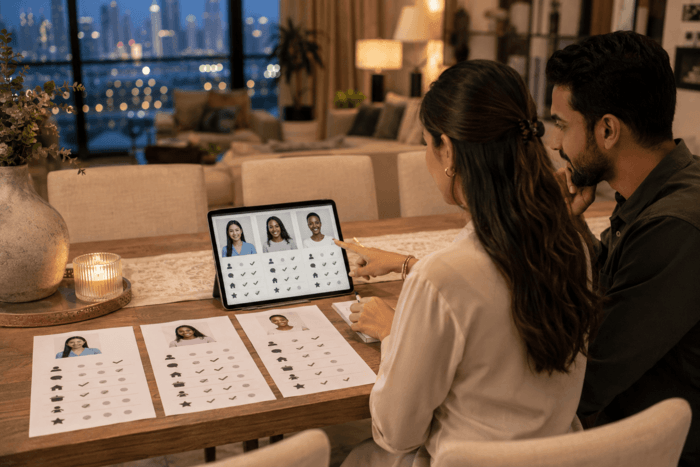
Once several interviews are complete, a new problem often appears.
The candidates begin to blur together.
You may remember that one candidate seemed friendly, another had excellent cooking experience, and another had worked in the UAE before—but important details become harder to separate.
This is why comparison should begin with your notes and original priorities rather than memory alone.
⏳ Don't Decide During the Call
Unless there is a genuine reason to make an immediate decision, give yourself time after the interview.
An engaging conversation can create a strong first impression.
A difficult first few minutes can create the opposite.
Neither should automatically determine the final choice.
Finish the interview, review your notes, and return to the requirements you identified before interviewing.
📝 Complete Your Notes Immediately Afterwards
Do not wait until the end of the day if you are interviewing several candidates.
Record the important information while the conversation is fresh.
Your notes might include:
- Relevant experience.
- Strongest skills.
- Skills requiring training.
- Communication level.
- Childcare experience where relevant.
- Important expectations.
- Candidate questions.
- Information requiring verification.
- Main positive signs.
- Any concerns.
- Overall suitability.
Keep observations factual where possible.
Instead of writing:
"I didn't like her answer."
write:
"Profile lists independent cooking experience, but candidate said previous employer usually prepared the meals."
The second note gives you something concrete to evaluate.
⚖️ Compare Candidates Against the Same Priorities
Return to the Must Have | Important | Nice to Have framework you created before the interviews.
Suppose childcare is your biggest requirement.
Candidate A may have excellent cooking skills, previous UAE experience, and strong ironing ability.
Candidate B may have fewer additional skills but several years of directly relevant toddler-care experience.
If childcare is genuinely your Must Have requirement, Candidate B may still be the stronger match.
Do not allow attractive secondary skills to replace your original priorities.
🧠 Separate Facts from First Impressions
First impressions are unavoidable.
But they should not be treated as evidence by themselves.
Try separating your assessment into two columns:
| Evidence from Interview | Personal Impression |
|---|---|
| Cared for children aged 2 and 5 | Seemed quiet |
| Explained daily childcare routine clearly | Appeared nervous initially |
| Can prepare five family meals independently | Seemed friendly |
| Asked for clarification twice | Spoke cautiously |
| No experience with pets | Seemed confident |
The left column should carry more weight.
Personality matters in a live-in working relationship, but vague impressions should not override relevant evidence about ability and compatibility.
⭐ Use Weighted Priorities
If you are choosing between strong candidates, give greater weight to the areas your household actually depends on.
For example:
| Criterion | Importance | Candidate A | Candidate B |
|---|---|---|---|
| Childcare experience | High | ★★★★★ | ★★★ |
| Communication | High | ★★★★ | ★★★★★ |
| Cleaning | High | ★★★★ | ★★★★ |
| Cooking | Medium | ★★★ | ★★★★★ |
| Laundry & ironing | Medium | ★★★★ | ★★★★ |
| Overall compatibility | High | ★★★★★ | ★★★★ |
The stars are not meant to turn hiring into a mathematical formula.
They simply make your reasoning visible.
💡 DECISION TIP
Do not choose the candidate with the highest number of skills. Choose the candidate whose strongest skills match the responsibilities that matter most in your home.
✅ Complete Maid Interview Checklist
A checklist helps ensure that important information is not forgotten while keeping the interview structured and consistent.
You can divide the process into three stages.
📋 Before the Interview
- Define your family's Must Have requirements.
- Identify Important and Nice to Have skills.
- Review the candidate profile.
- Note relevant previous employment.
- Identify information that needs clarification.
- Prepare your core questions.
- Prepare one or two relevant scenario questions.
- Decide who will attend.
- Create a simple scorecard.
- Allow enough time for a real conversation.
🗣️ During the Interview
- Introduce yourself and your family.
- Explain the purpose of the conversation.
- Describe the household accurately.
- Explain the main responsibilities.
- Discuss relevant previous experience.
- Ask open-ended questions.
- Request examples where appropriate.
- Explore your highest-priority skills.
- Observe practical communication.
- Clarify important inconsistencies.
- Discuss areas where training may be required.
- Explain expectations realistically.
- Allow the candidate to ask questions.
- Take useful notes.
📝 After the Interview
- Complete your scorecard immediately.
- Record important facts.
- Note positive signs.
- Record concerns requiring verification.
- Identify unanswered questions.
- Compare the candidate against your Must Have requirements.
- Separate evidence from first impressions.
- Arrange a second interview if necessary.
- Compare shortlisted candidates consistently.
- Avoid rushing simply because the interview went well.
🔄 The Complete Interview Journey
BEFORE
Needs → Profile → Priorities → Questions
↓
DURING
Explain → Ask → Listen → Observe → Clarify
↓
AFTER
Notes → Compare → Verify → Decide
Families choosing a new maid should also think beyond the interview itself. Our Guide to Choosing a Full-Time Maid explains other factors that can help when moving from candidate assessment toward the final hiring decision.
🚫 Common Maid Interview Mistakes to Avoid
Even a long interview can produce poor information if it is conducted in the wrong way.
Some mistakes make it difficult to understand the candidate. Others create unrealistic expectations before the employment relationship has even begun.
❌ Asking Only Yes/No Questions
This is one of the most common problems.
Questions such as:
"Can you clean?"
"Can you cook?"
"Do you like children?"
are easy to answer but reveal little.
Better approach: Ask candidates to describe what they have actually done.
❌ Talking More Than the Candidate
You need to explain your household and expectations, but the candidate also needs enough time to speak.
If you spend most of the interview describing your family, you may finish knowing very little about her experience.
Better approach: Explain the necessary context, ask a question, and then listen.
❌ Asking Too Many Questions Without Following Up
Twenty shallow questions may reveal less than ten well-chosen questions with useful follow-ups.
If an answer relates directly to one of your priorities, explore it.
Better approach: Follow relevant information rather than rushing through a script.
❌ Choosing Based Only on Years of Experience
Ten years of experience sounds impressive.
But ten years in roles unrelated to your main needs may be less useful than three years of highly relevant experience.
Better approach: Evaluate both duration and relevance.
❌ Focusing Only on Cleaning Skills
Domestic work can involve much more than cleaning.
Depending on the household, communication, laundry, cooking, organisation, childcare-related support, and ability to follow routines may be equally important.
Better approach: Evaluate the complete role you actually need.
❌ Ignoring Communication Compatibility
A candidate may have excellent technical skills, but if important daily instructions cannot be understood by either side, the working relationship may become difficult.
Better approach: Assess communication naturally throughout the interview.
❌ Assuming Every Maid Is Also a Nanny
Household support and dedicated childcare are different responsibilities.
Better approach: If childcare is central to the role, assess relevant childcare experience specifically.
❌ Describing the Job Vaguely
Phrases such as "normal household work" leave room for very different interpretations.
Better approach: Explain the main responsibilities and priorities clearly.
❌ Making a Decision Based on One First Impression
A candidate may be nervous during the first few minutes.
Another may be naturally confident in interviews.
Neither tells you enough about future job performance.
Better approach: Judge the complete conversation and relevant evidence.
❌ Interviewing Several Candidates Without Taking Notes
After several interviews, details become difficult to remember accurately.
Better approach: Use the same simple scorecard for every candidate and complete it immediately.
❌ Expecting the Candidate to Agree with Everything
Automatic agreement is not necessarily a positive sign.
You need accurate information, not the answer you hope to hear.
Better approach: Create an interview environment where the candidate can honestly explain what she knows, what she does not know, and what she needs clarified.
⚠️ COMMON INTERVIEW TRAP
Do not ask questions designed to make the candidate give the "right" answer. Ask questions that help you discover the real answer.
🧠 The 24-Hour Rule: What to Do After the Interview
The interview ends when the call finishes.
The decision-making process should not.
Giving yourself a short period to review what you learned can prevent a strong emotional first impression from becoming the only reason for hiring someone.
📝 Write Down What You Learned Immediately
Within a few minutes of finishing, record the important facts.
Do not depend on remembering them tomorrow.
Write down:
- Strongest relevant experience.
- Main skills.
- Communication observations.
- Areas requiring training.
- Important expectations.
- Candidate questions.
- Concerns.
- Information requiring verification.
⚖️ Separate "I Liked Her" from Evidence
It is perfectly reasonable to feel more comfortable speaking with one candidate than another.
But ask yourself:
Why?
Then look for evidence.
Was communication particularly clear?
Did she have experience matching your children's ages?
Did she understand the household role?
Did she give strong examples?
Or did the conversation simply feel pleasant?
A positive personal impression can be part of the decision, but it should sit alongside job-relevant evidence.
🔍 Identify One Remaining Concern
Ask yourself:
"What is the most important thing I am still unsure about?"
Perhaps it is cooking ability.
Perhaps childcare experience needs clarification.
Perhaps an employment date does not match the profile.
Perhaps your spouse wants to speak with the candidate.
Identifying the uncertainty makes the next step clear.
📞 Decide Whether You Need a Follow-Up
If an important question remains unanswered, a short second conversation may be better than guessing.
A follow-up can focus only on the missing information.
There is no need to repeat the entire interview.
🎯 Return to Your Original Must-Haves
Before making the final choice, look again at the priorities you defined before meeting any candidates.
Has the candidate met them?
If not, are you changing your priorities for a good reason—or because you were impressed by unrelated strengths?
This final check can protect you from choosing an attractive candidate who does not actually match the role.
🔄 Interview to Decision
INTERVIEW
↓
WRITE NOTES
↓
CHECK EVIDENCE
↓
COMPARE WITH MUST-HAVES
↓
CLARIFY GAPS
↓
VERIFY WHERE NEEDED
↓
DECIDE
A careful interview cannot guarantee that every employment relationship will work perfectly.
But it can significantly reduce avoidable mismatches by helping both sides understand what they are agreeing to before the job begins.
🌟 From a Good Interview to the Right Hiring Decision
A successful interview does not remove every uncertainty from the hiring process.
Its purpose is to give both the family and the candidate enough reliable information to make a better decision.
By the end of the interview process, you should have a clearer understanding of:
- The candidate's real previous experience.
- Her strongest household skills.
- Areas where she may need training.
- Her ability to communicate with your family.
- Whether her childcare experience matches your needs.
- Her understanding of the role.
- Any important expectations that require clarification.
- Whether her overall experience suits your household priorities.
Remember that some skills can be taught.
A candidate may learn your preferred cleaning routine, become familiar with a new appliance, follow your recipes, or adapt to the way you organise laundry.
Other mismatches can be much harder to solve.
If your household requires extensive newborn care and the candidate has never cared for a baby, training needs may be substantial. If communication is essential to the role but both sides struggle to understand each other, everyday coordination may remain difficult. If the candidate expects a substantially different role, the problem cannot simply be solved by adding more instructions later.
The final decision should therefore focus on the overall match, not perfection.
A good hiring process follows a logical path:
PROFILE → INTERVIEW → VERIFY → COMPARE → CHOOSE → SET EXPECTATIONS
Once you have selected a candidate, the next stage is equally important.
Clear introductions, realistic training, consistent communication, and time to understand the household can help turn a successful interview into a successful working relationship. Our guide to the first month with your new maid explains how families can manage this important adjustment period after hiring.
❓ Frequently Asked Questions
-
How long should a maid interview take?
A maid interview will often take around 20 to 40 minutes, although there is no ideal duration for every candidate. The conversation should be long enough to discuss relevant experience, important household skills, communication, expectations, and the candidate's questions without unnecessarily extending the interview.
-
What should I ask a maid during an interview?
Ask about previous employment, daily responsibilities, the skills most relevant to your household, childcare experience if applicable, cooking ability, communication, and expectations about the role. Open-ended questions and requests for real examples generally provide more useful information than a long list of yes/no questions.
-
How can I tell if a maid has real experience?
Ask the candidate to describe previous households, daily routines, children's ages, meals she prepared, cleaning responsibilities, or other tasks she claims to have performed. Genuine experience can often be explained through practical details and examples. Important information should also be verified through the appropriate recruitment process rather than relying on the interview alone.
-
Should I interview a maid more than once?
A second interview can be useful when important questions remain unanswered, childcare will be a major responsibility, two candidates are closely matched, another family decision-maker needs to participate, or the first interview was affected by communication or technical problems. The second conversation should focus on unresolved points rather than repeating the entire first interview.
-
Is a video interview enough before hiring a maid?
A video interview can provide valuable information about experience, communication, expectations, and general suitability, particularly when interviewing overseas candidates. Whether additional assessment is needed depends on the role, the candidate's location, and any questions that remain after the first interview.
-
What should I look for when interviewing a nanny?
Focus particularly on age-specific childcare experience, daily routines, safety awareness, communication, feeding or meal responsibilities where relevant, activities, and how the candidate responds to ordinary childcare situations. The candidate's previous experience should match the ages and level of care your children actually require.
-
Should I choose the maid with the most experience?
Not necessarily. Relevant experience is usually more valuable than the highest number of years. A candidate with three years of experience closely matching your household's priorities may be more suitable than someone with ten years of experience in very different roles.
-
What are the biggest warning signs during a maid interview?
Important warning signs can include major inconsistencies between the interview and candidate profile, inability to explain claimed experience, repeatedly agreeing to skills without providing examples, significant communication problems for a communication-heavy role, or major differences between the candidate's expectations and the actual job. Nervousness alone should not be treated as a warning sign.
-
Should the maid be allowed to ask questions during the interview?
Yes. The candidate should have an opportunity to understand the family, responsibilities, children, household routine, and other relevant aspects of the role. Sensible questions can demonstrate that she is listening carefully and trying to determine whether the position is suitable for her as well.
📞 A Better Interview Can Lead to a Better Match
A candidate profile may help you create a shortlist, but the interview is where you begin to understand whether a particular maid could genuinely fit your household.
The most useful interviews are not the longest or the most complicated.
They are the ones where families prepare properly, ask relevant questions, listen carefully, look for real examples, explain the role honestly, and give the candidate an opportunity to understand what will be expected of her.
Do not search for perfect answers.
Look for relevant experience, effective communication, realistic expectations, honesty about strengths and limitations, and a genuine match with your family's priorities.
Ezee Workers Employment Services Center helps UAE families explore qualified domestic worker candidates and make the hiring process clearer from candidate selection through employment.
If you are ready to interview candidates or need help choosing domestic support that matches your household, contact us and our team will be happy to assist you.