Hiring a full-time maid is about more than finding someone to help with household tasks.
A successful long-term working relationship begins when both the family and the domestic worker clearly understand their responsibilities, expectations, and daily routines.
While every household is different, most responsibilities fall within a well-defined framework based on the employment agreement, the family's lifestyle, and the role the maid has been hired to perform.
This guide explains the most common maid responsibilities in Dubai, highlights professional standards, outlines the legal framework governing domestic work, and offers practical advice that helps families create a respectful and well-organised home environment.
⚖️ Understanding Maid Responsibilities in Dubai
A maid's responsibilities are not identical in every household.
The agreed duties depend on several factors, including the family's needs, the number of household members, whether childcare is required, and the terms outlined in the employment contract.
For this reason, discussing responsibilities before employment begins is one of the most important steps in building a successful working relationship.
Families that recruit through licensed maid agency services often receive guidance on defining responsibilities clearly before the maid starts work, reducing misunderstandings later.
💡 Tip: A written list of responsibilities discussed during onboarding helps both the family and the domestic worker understand expectations from the very beginning.
🏛️ Legal Responsibilities and Employment Standards
Domestic workers in the UAE are employed under a regulated legal framework designed to protect both employers and workers. Employment contracts define the agreed responsibilities, while UAE regulations establish important rights and obligations for both parties.
In addition to completing the necessary maid visa procedures, families should ensure that responsibilities remain consistent with the agreed role and employment contract.
For example, UAE regulations require domestic workers to perform the agreed work diligently, respect household privacy, safeguard the employer's property, and follow lawful instructions related to their role. At the same time, employers are required to provide suitable accommodation, agreed wages, medical care or health insurance, and a respectful working environment.
🏡 Core Household Responsibilities
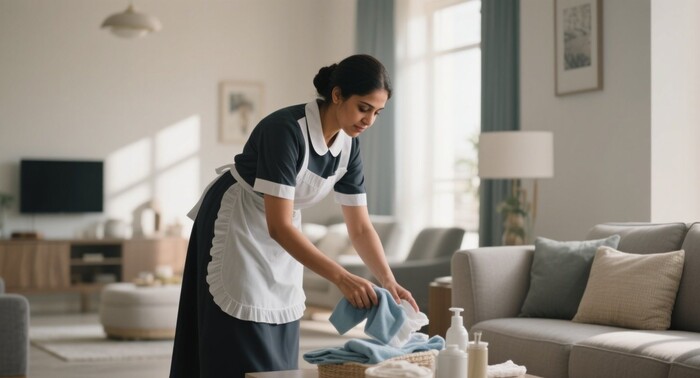
For most households, daily housekeeping remains the primary responsibility of a full-time maid.
Although routines vary from one family to another, these responsibilities commonly include maintaining cleanliness, organising living spaces, and helping the household operate efficiently throughout the week.
Typical housekeeping responsibilities include:
- 🧹 Cleaning bedrooms, bathrooms, kitchens, and living areas.
- 🪟 Dusting, vacuuming, and mopping floors.
- 🧺 Laundry, ironing, and wardrobe organisation.
- 🛏️ Making beds and maintaining tidy bedrooms.
- 🗑️ Emptying bins and keeping shared spaces organised.
Rather than focusing on deep cleaning every day, many families prefer establishing consistent routines that keep the home clean and organised with less effort over time.
🍽️ Meal Preparation and Kitchen Support
Cooking responsibilities vary considerably between households.
Some families simply require assistance with meal preparation, while others expect the maid to prepare daily meals according to family preferences and dietary requirements.
Depending on the agreed role, kitchen-related responsibilities may include:
- Preparing breakfast, lunch, or dinner.
- Washing and organising kitchen equipment.
- Assisting with food preparation.
- Maintaining kitchen hygiene.
- Organising groceries and basic household supplies.
When cooking forms part of the agreed duties, providing clear guidance about family preferences and routines helps avoid misunderstandings and creates a smoother daily workflow.
👶 Childcare Responsibilities
In many households, childcare forms an important part of a maid's daily routine. However, the level of responsibility depends entirely on the family's requirements and the role agreed upon before employment begins.
Where childcare is included, a maid may assist with everyday routines rather than replacing the role of parents.
Typical childcare responsibilities may include:
-
👶 Helping children get ready for school.
-
🍼 Preparing meals or snacks.
-
🧸 Supervising playtime.
-
📚 Assisting with homework or daily routines.
-
🛏️ Helping maintain children's bedrooms and belongings.
Families whose primary requirement is professional childcare may prefer hiring a dedicated nanny, while others find that a full-time maid who also provides childcare support is the better solution for their household.
👵 Elderly Care and Additional Household Support
Some households may also require assistance with elderly family members or adults who need occasional daily support.
Depending on the agreed responsibilities, a maid may help with:
-
Assisting with simple daily activities.
-
Preparing meals and drinks.
-
Helping maintain a clean and comfortable living environment.
-
Providing companionship during routine household activities.
These responsibilities should always be clearly discussed before employment begins to ensure that both the family and the domestic worker understand the scope of the role.
📅 Daily Organisation and Time Management
Managing time efficiently is one of the qualities that separates an experienced domestic worker from an inexperienced one.
Rather than completing tasks randomly, successful maids usually follow an organised routine that balances daily priorities with less frequent household duties.
A typical weekly approach may look like this:
| Daily Responsibilities | Weekly Responsibilities |
|---|---|
| 🧹 General cleaning | 🪟 Deep cleaning selected areas |
| 🍽️ Kitchen organisation | 🧺 Wardrobe organisation |
| 🛏️ Making beds | 🧹 Cleaning appliances |
| 🧺 Laundry | 🪴 Organising storage areas |
💡 Tip: A simple daily checklist helps families communicate priorities clearly while giving the maid greater confidence in managing household routines independently.
🤝 Professional Conduct Inside the Home
Technical skills alone do not define an excellent domestic worker.
Professional behaviour is equally important in building trust and maintaining a positive household environment.
Families generally value domestic workers who demonstrate:
-
✅ Respect for household routines.
-
✅ Punctuality and reliability.
-
✅ Care when handling household belongings.
-
✅ Willingness to learn.
-
✅ Positive communication.
-
✅ Flexibility when priorities change.
These qualities often contribute more to a successful long-term relationship than experience alone.
🔒 Privacy, Confidentiality, and Trust
Domestic workers become part of a family's private daily life.
For that reason, trust and confidentiality are essential responsibilities.
Professional standards include:
-
Respecting the family's privacy.
-
Keeping household information confidential.
-
Using household property responsibly.
-
Maintaining appropriate professional boundaries.
-
Protecting personal information belonging to family members.
Likewise, families should create a respectful environment where mutual trust develops naturally over time.
📌 Good household relationships are built on mutual respect, clear communication, and trust—not simply on completing daily tasks.
⚠️ Responsibilities That Should Be Clearly Agreed
One of the most common reasons for misunderstandings between families and domestic workers is assuming that every household follows the same expectations.
In reality, responsibilities vary from one family to another. While some households expect cooking and childcare support, others may require only housekeeping and laundry.
For this reason, families should clearly discuss responsibilities before employment begins and review them together during the first few weeks.
The following table provides a simple example.
| Usually Included | Depends on the Agreement |
|---|---|
| 🧹 House cleaning | 🍳 Cooking full daily meals |
| 🧺 Laundry and ironing | 👶 Full-time childcare |
| 🛏️ Making beds | 👵 Elderly assistance |
| 🗑️ Household organisation | 🛒 Grocery shopping |
| 🍽️ Kitchen cleaning | 🐾 Pet care |
📌 Every household is unique. Clearly defining responsibilities before employment begins helps both the family and the maid work together with confidence and reduces the likelihood of misunderstandings later.
💬 Communication Creates Better Results
Even the most experienced maid cannot meet expectations that have never been explained.
Clear communication allows household routines to develop naturally while giving the maid confidence in carrying out daily responsibilities.
Families can improve communication by:
-
📋 Explaining priorities instead of assuming they are understood.
-
💬 Giving instructions clearly and respectfully.
-
🔄 Reviewing routines whenever household needs change.
-
👍 Recognising good performance as well as providing constructive feedback.
-
🤝 Encouraging questions whenever something is unclear.
Simple conversations often prevent small misunderstandings from becoming larger problems.
🌟 Supporting Professional Growth
Domestic work is a profession that develops with experience.
Many domestic workers improve their performance over time by becoming familiar with a family's routines and learning more efficient ways to organise household tasks.
Families can support this development by:
-
📖 Introducing household routines gradually.
-
🍽️ Explaining preferred cooking methods.
-
👶 Demonstrating childcare routines where necessary.
-
🏡 Allowing time to adapt during the first weeks.
-
🌱 Encouraging continuous learning and improvement.
Investing a little time during the onboarding period often leads to better organisation, stronger trust, and a more productive long-term working relationship.
✅ Checklist for Families
Before employment begins, it helps to confirm that both the family and the maid have the same understanding of the role.
✔️ Daily responsibilities are clearly explained.
✔️ Weekly tasks have been discussed.
✔️ Working hours and routines are understood.
✔️ Household preferences have been communicated.
✔️ Expectations for childcare or cooking are agreed.
✔️ Questions have been answered before the first working day.
A clear start creates confidence for both parties and makes the transition into daily household life much smoother.
❓ Frequently Asked Questions
-
What are the main responsibilities of a full-time maid?
Most full-time maids assist with housekeeping, laundry, meal preparation, and household organisation. Additional responsibilities such as childcare or elderly support depend on the family's needs and the agreed employment terms.
-
Can a maid's responsibilities change after employment begins?
Yes. Household needs often change over time. Any new responsibilities should be discussed openly so that both the employer and the maid understand the updated expectations.
-
Should every task be written down?
A written task list is highly recommended. It helps both parties understand daily priorities, reduces misunderstandings, and makes onboarding much easier.
-
What if the family needs responsibilities beyond normal housekeeping?
Responsibilities can vary from one household to another, provided they are clearly agreed before employment begins and remain consistent with the employment arrangement.
-
Where can I learn more about choosing the right domestic worker?
If you're still comparing candidates, our Guide to Choosing a Full-Time Maid explains the key factors families should consider before making a hiring decision.
📞 Clear Responsibilities Lead to Better Relationships
Clearly defined responsibilities help create a more organised home, improve communication, and build trust between families and domestic workers from the very beginning.
At Ezee Workers Employment Services Center, we help families compare candidate profiles, understand different recruitment options, and choose qualified domestic workers whose skills match their household's needs.
If you're looking for professional guidance or would like help finding the right domestic worker, contact us and our team will be happy to assist you.